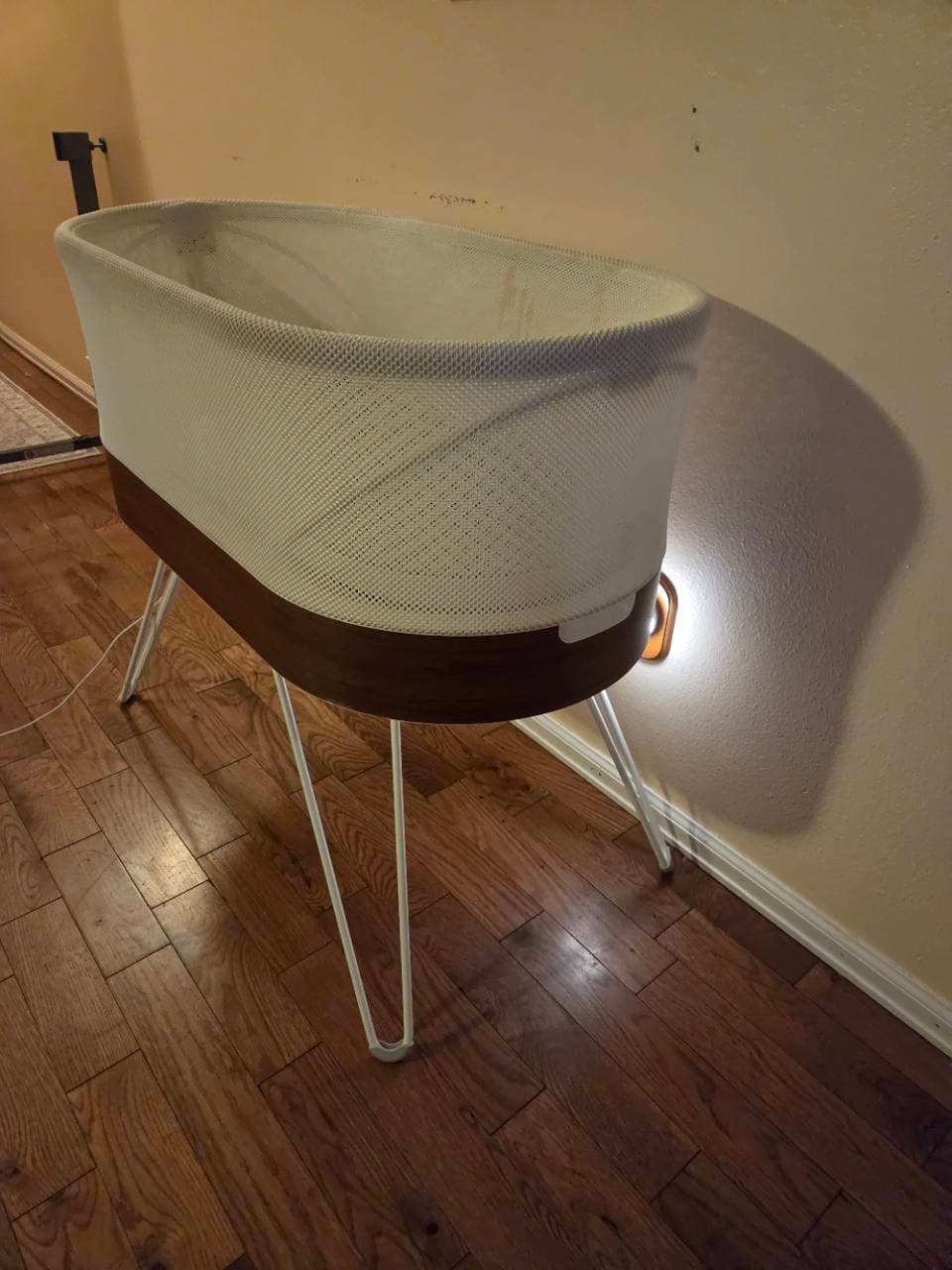
You should stop using SNOO when your baby reaches any of the manufacturer's limits—not when all of them happen at once.
Happiest Baby describes SNOO as intended from birth to about 6 months, for babies weighing 5 to 25 pounds, or until a baby can push up on hands and knees, whichever comes first. Your current manual and pediatrician take priority over a blog post.
The quick stop-using-SNOO checklist
Begin the transition or stop sooner if:
- Your baby reaches the age or weight limit in the current instructions.
- Your baby can push up on hands and knees.
- The sack no longer fits within the approved size and setup.
- Any clip, mesh, zipper, mattress, platform, cord, or structural part is damaged.
- The bassinet behaves unexpectedly or displays a persistent error.
- Your pediatrician recommends a different sleep setup.
- You cannot use the bassinet exactly as the manufacturer directs.
Do not extend use by adding padding, positioning devices, a different mattress, an improvised restraint, or an incline.
Age limit vs weight limit: which one wins?
Whichever stopping point happens first.
A smaller six-month-old does not automatically get extra months because they are below 25 pounds. A younger baby who reaches the weight or mobility limit does not need to wait for the calendar. Development can matter before either number.
The official Happiest Baby intended-use information is the source to check for current limits. Save the manual that came with your model and look for product updates before relying on an old screenshot or forum answer.
What if my baby is rolling?
Rolling requires two separate decisions:
- Swaddling and product use inside SNOO. The SNOO Sack uses clips designed to keep a baby positioned on the back when used correctly. Follow the SNOO instructions and speak with your pediatrician if your baby's movement or development raises questions.
- Sleep after moving to a crib. The AAP says babies should be placed on their backs for every sleep. Once a baby can roll from back to stomach and stomach to back independently, the baby can remain in the position they reach on their own—but the crib should stay firm, flat, and bare. Ordinary swaddling should stop when a baby shows signs of trying to roll.
Do not use a positioner or loose item to prevent rolling in a crib.
How to transition out of SNOO
You do not need to change the sack, motion, room, and bedtime routine on the same night unless a safety limit requires an immediate stop. When there is time to prepare, change one variable at a time.
Step 1: Protect the bedtime routine
Keep the boring, repeatable parts: feed, diaper, pajamas, dim lights, short song, and the same general bedtime window. The location is changing; the entire evening does not have to.
Step 2: Practice arms out
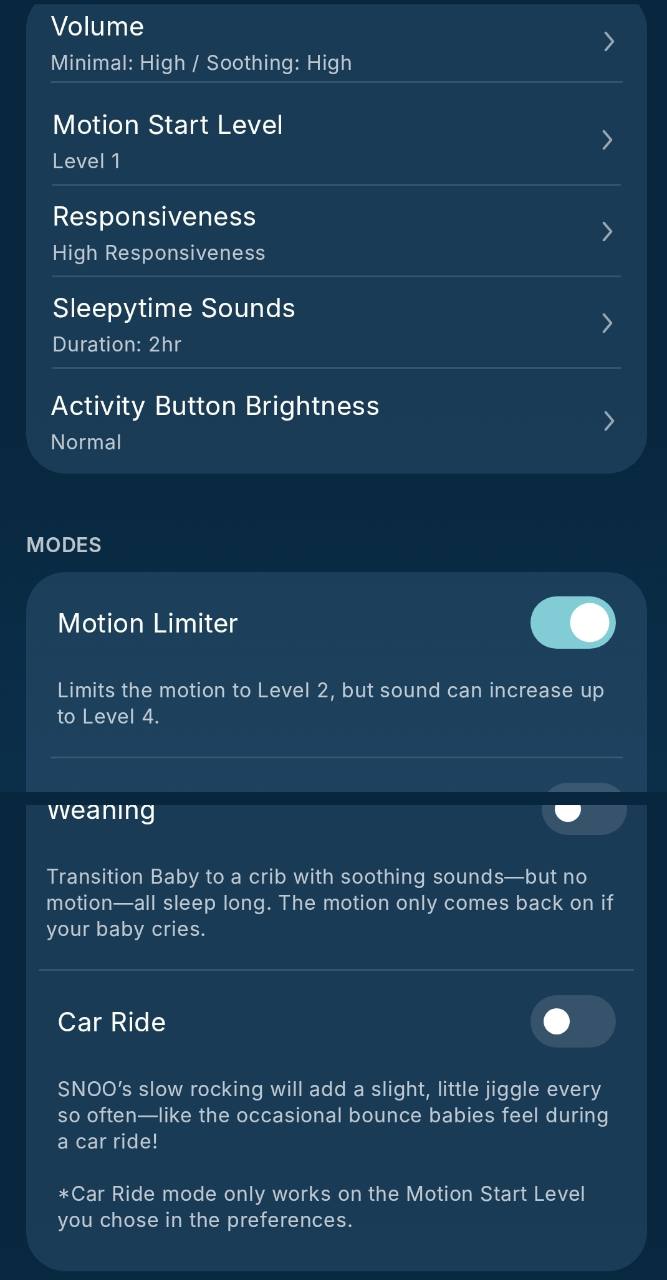
Happiest Baby's Weaning Mode guidance recommends first using the designated shoulder openings so the baby sleeps with arms free. Wait until arms-out sleep is going reasonably well before removing all baseline motion.
Some families try one arm first, then two. Use only the openings and configuration described for your sack; do not alter it.
Step 3: Turn on Weaning Mode
In Weaning Mode, the sound continues but baseline motion stops. If the baby fusses, SNOO can still respond with motion and sound. This is a bridge between all-night motion and a stationary crib.
Give the baby a few nights to show you whether the change is manageable. A rough first night is information, not proof that the transition failed.
Step 4: Start with the easiest crib sleep
Some babies handle the first stretch of nighttime sleep best; others tolerate a morning nap more easily. Pick the sleep period that is usually most predictable rather than forcing every nap into the crib on day one.
Use a safety-approved crib with its own firm mattress and fitted sheet. Do not move the SNOO mattress or sack into the crib.
Step 5: Move fully to the crib
Once arms-out, stationary sleep is tolerable—or once a product limit requires the change—use the crib for all sleep. Keep placing the baby on their back. Keep the crib empty.
The AAP recommends room sharing without bed sharing, ideally for at least the first six months. Moving out of SNOO does not automatically mean moving the baby to a separate room.
How long should SNOO Weaning Mode take?
There is no universal number. A practical trial is several nights with arms out, followed by several nights in Weaning Mode, then the crib. Some babies need less. Some need a slower change.
Do not let a preferred schedule override a safety or developmental limit. If the baby has outgrown the product, the answer is the crib—not another week of practice.
Signs the transition is going normally
Normal does not mean silent. Common adjustment signs include:
- more help settling at bedtime
- shorter first stretches for a few nights
- extra wake-ups while the baby learns the still sleep surface
- hands touching the face after arms-out swaddling
- naps changing before nighttime sleep, or the reverse
Call your pediatrician if sleep changes come with breathing difficulty, poor feeding, unusual lethargy, fever, persistent inconsolable crying, or anything that feels medically wrong. Those are not “sleep training” problems to troubleshoot online.
What belongs in the crib after SNOO?
The baby, a firm mattress made for the crib, and a snug fitted sheet. That is it.
The CPSC says “Bare Is Best”: no pillows, loose blankets, padded bumpers, quilts, comforters, positioners, or stuffed toys. The AAP also recommends a separate, firm, flat sleep surface and placing infants on their backs.
If the room is cool, use appropriately fitted sleep clothing or a non-weighted wearable blanket suited to the baby's development. Do not add loose bedding.
Plan before the final week
You can make the transition less frantic by having these ready:
- assembled safety-approved crib
- firm crib mattress made for that crib
- two snug fitted sheets
- age-appropriate non-weighted sleep clothing
- current SNOO return instructions if renting
- original rental box and inserts
- a plan for app or white-noise changes
- pediatrician questions written down before the next visit
If you are renting, start the return process only after reading the current terms. Happiest Baby says the original box and inserts are needed for return, and return shipping is charged under the current US rental policy.
Complete your SNOO plan
- SNOO rent vs buy calculator
- Our firsthand SNOO review after three months
- SNOO Weaning Mode guide
- SNOO levels explained
- SNOO sleep sack size chart and fit checks
- SNOO fitted sheet compatibility and care
- Our firsthand first-three-months sleep story