
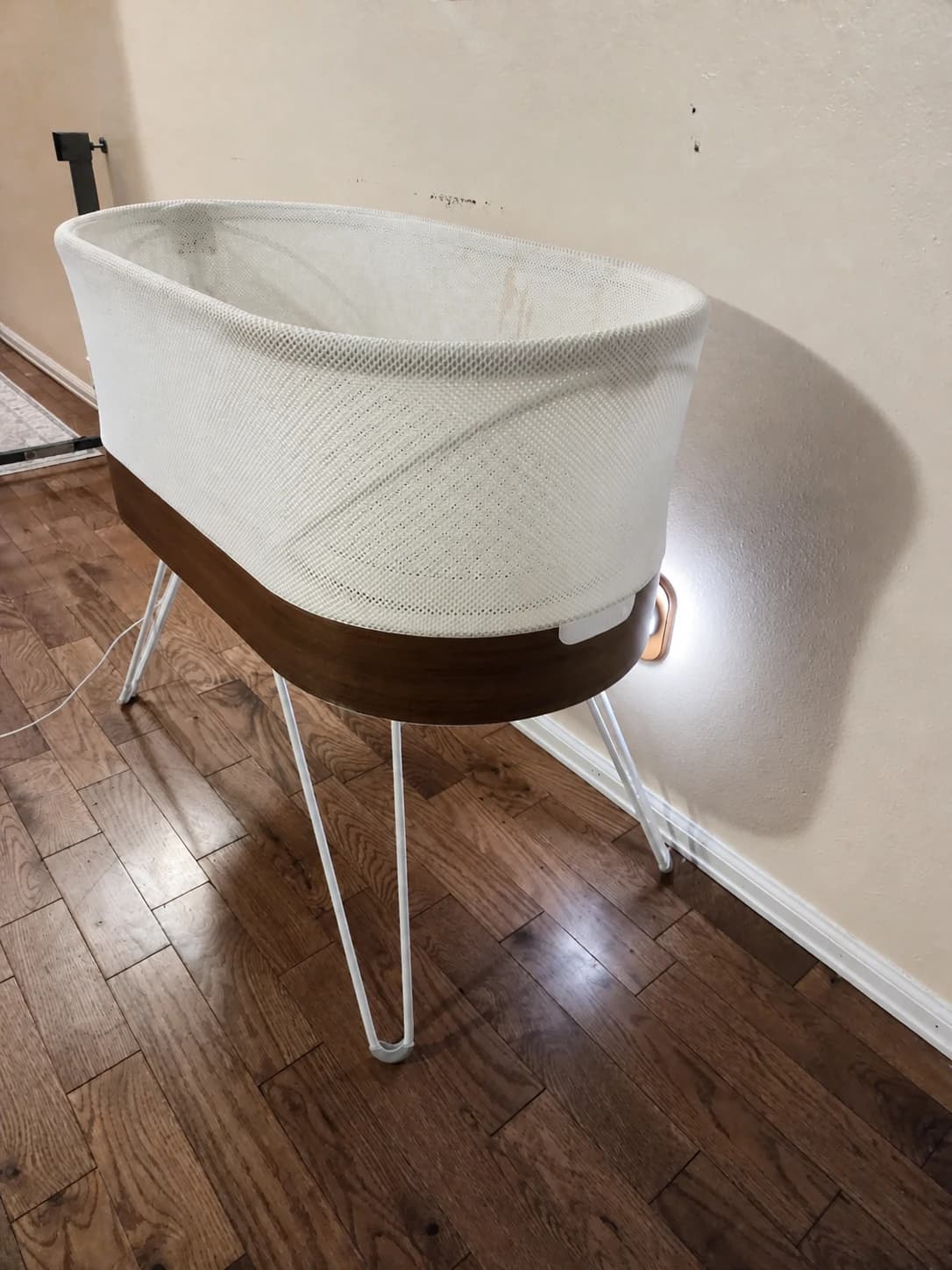
Nobody prepares you for the specific flavor of exhaustion that is the newborn stage. Not really. People say "sleep when the baby sleeps" like that's useful advice when the baby only sleeps while actively on top of you, at a precise 37-degree angle, while you hold your breath and pray.
This is the story of our first three months, and our answer to the question we kept asking while exhausted: was the SNOO actually worth it?
The First Few Weeks: Constant Contact Hours
Our baby did not want to be put down. Like, at all. The second we tried to transfer her to a bassinet or pack-and-play set up for safe sleep, she woke up immediately and let us know, loudly, that this was not acceptable.
She wanted to be held. All the time. Skin-to-skin, chest-to-chest, the full human contact experience. Which is completely normal and biologically makes total sense. We knew that. We understood the science. We also understood that two adult humans need a few consecutive hours of sleep per night to function as, you know, people.
So we did what a lot of new parents end up doing: shift changes.
I was very lucky that my husband took the night shift. I'd wake up at 6 AM to take over, and he'd get a few hours of sleep after that. Sometimes he'd let me sleep in until 8 AM. He had great paternity leave, which made it possible for us to manage this routine, even though he was getting by on just a few hours of sleep.
The Co-Sleeping Conversation
Pretty early on, well-meaning friends and family started suggesting co-sleeping. Which, look, we understand why. A lot of people do it, a lot of people love it, and there's a whole movement around it. We're not here to tell anyone how to parent their kid.
But for us, in our specific situation, it didn't feel like the right call. We were both so exhausted we were barely functioning. The risk of one of us not waking up, rolling over, something going wrong. We just couldn't get comfortable with it. Our sleep-deprived brains were not operating at full safety-conscious capacity, and that felt like exactly the wrong time to introduce bedsharing.
So we kept doing the shift change. And we kept being destroyed by it.
Enter the SNOO
As our baby got closer to six weeks, my husband had to go back to work full time. He couldn't keep staying up all night rocking her until 6 AM and then work a full day.
I started to panic. The only reason I was getting any sleep was that he was staying up with her. She still wouldn't sleep on her own, and we needed to figure something out before he went back.
My husband said, "We have to do something," and found out about the SNOO on Reddit. He told me some people were saying it would ruin the baby's sleep, which made us nervous about trying it.
Then we found out our OB had used a SNOO with their own baby too. That put our minds at ease.
That was enough for us. We got one.
When we picked it up from a family on Facebook Marketplace, they told us they'd gone six weeks without sleep before finally breaking down and buying one. They said it was a game changer for them. We hoped it would help us too, but we didn't want to get our hopes up.
The Adjustment Week
I will tell you honestly: the first week with the SNOO was not magic. Our daughter was not immediately converted. She had gotten used to being held, to human warmth, to the sound of actual breathing, and the SNOO, good as it is, is a machine.
She fussed. She woke up more times than she had been waking up with us. There were a few nights where we looked at each other and wondered if we'd made an expensive mistake.
We stuck with it. We kept the routine consistent. We kept doing what the SNOO app suggested. And somewhere around the end of that first week, something clicked.
The Two-Hour Window
It started small. One night she went down in the SNOO and didn't immediately protest. Then she stayed down for 45 minutes. Then an hour.
And then one night she went down and stayed down for two full hours. I remember that night so clearly.
Two hours sounds like nothing. Pre-baby me would have laughed at two hours as a meaningful sleep achievement. But at that point in our lives, two consecutive hours meant we could both sleep at the same time. We didn't have to run shifts. We could actually lie down together, close our eyes, and sleep.
I cried a little. I'm not embarrassed about it.
What We Learned
Honestly, the thing that helped most was lowering the bar. "Sleeping through the night" is a myth for most newborns. Two hours was a win. Three hours was a celebration. Once we stopped measuring against some impossible standard, every small improvement felt like a real victory instead of a failure.
It's also temporary, which isn't useful to hear at 3 AM but is genuinely true. The contact-only phase passes. The SNOO phase passes. It all passes, which is bittersweet but also reassuring when you're in the thick of it.
The SNOO isn't for everyone, but it was for us. If you have family nearby, a partner with real flexibility, or people who can take the baby and send you to bed for four actual hours, you might be fine without it. But if you're doing this with limited help, two working parents, and nobody nearby to give you a real break, the SNOO is the kind of thing that can make a material difference. Not magic. Just reliably, dependably helpful when you need it most.
Three Months In
By three months, we were different parents than we were at six weeks. Not because everything was easy, but because we'd found a rhythm. We knew our baby better. She knew us. The SNOO had done its job during the hardest stretch. We were sleeping, imperfectly but meaningfully, and that made everything else more manageable.
If you're in the early weeks right now and you're running on nothing: it does get better. Not all at once, not on a schedule, not the way the books say it will. But it gets better.
And if you need a little machine to help you get there, no shame in that at all.
So, Was SNOO Worth It for Us?
Yes. It helped our contact-sleeping baby accept a separate sleep space long enough for both parents to sleep at the same time.
That is a much smaller promise than the fantasy people sometimes attach to a premium bassinet. It is also the result that mattered in our house. We moved from one parent always being awake to occasional two-hour stretches when both of us could lie down. At that point, two hours felt enormous.
The answer would have been different if paying for it displaced rent, food, medical care, or emergency savings. It also would have been different if our existing bassinet had already produced workable sleep, if we had abundant overnight help, or if we had started with only a few usable weeks left.
What It Helped
- Transfers lasted longer. The motion and sound helped bridge the abrupt change from a moving human chest to a separate sleep surface.
- Some stirring did not become a full reset. Not every noise required starting the entire settling routine again.
- Both parents could sleep at once. That was the biggest practical and emotional benefit.
- The routine became repeatable. A consistent sack, transfer, and bassinet sequence reduced our 2 a.m. improvising.
What It Did Not Fix
- Feeding, diapers, and normal newborn waking. Our baby still needed a caregiver.
- Contact naps. Accepting the SNOO at night did not erase her preference for sleeping on a person at other times.
- Parental anxiety. We still listened for every sound and wondered whether we were doing things correctly.
- Bad nights. Growth, discomfort, and ordinary newborn chaos still happened.
- The eventual transition. SNOO is a short stage. We still had to learn sack sizing, arms-out sleep, Weaning Mode, and the move to a bare crib.
What We Would Do Differently
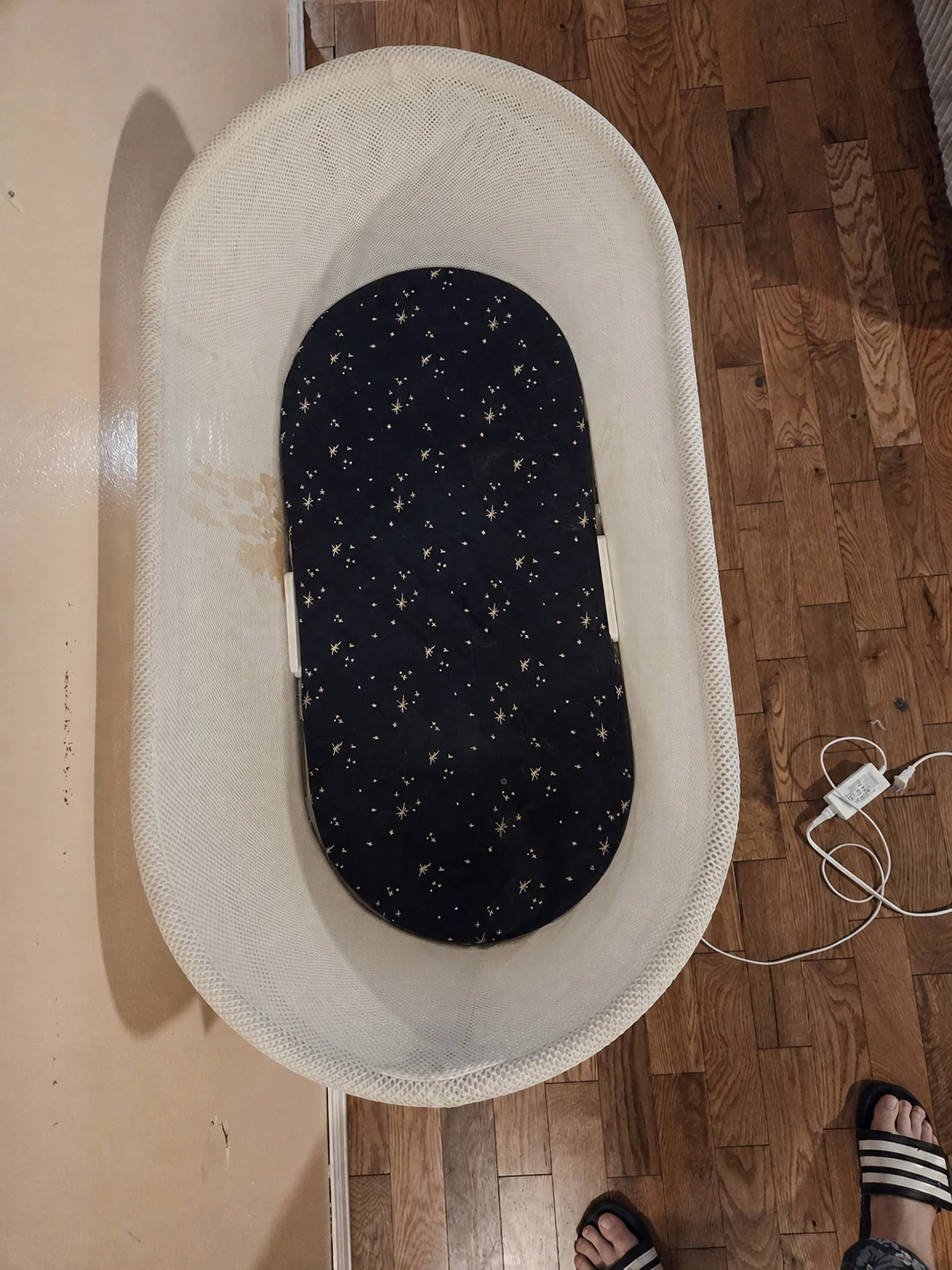
The coffee stain is ours, too
A tired momma spilled some coffee on the SNOO. There was no baby in it when it happened. That's what the brown mark on the mesh is. Real life, real mess, apparently right on brand.
What we'd change
We would have gotten the SNOO earlier.
If you are comparing rental and ownership, use the SNOO rental-vs-buy calculator with your real fees, remaining months, and conservative resale estimate. The right answer depends on the problem it solves and how long you can actually use it.
The practical SNOO guides I wish we had
A look at the underside
Here's a look at the underside. The legs come off, and the power cord plugs into the bottom. That was pretty convenient because we actually took it to hotel rooms with us on a few small road trips. It was somewhat easy to pack, but it's a little heavy, so I made my husband carry it to and from the car.
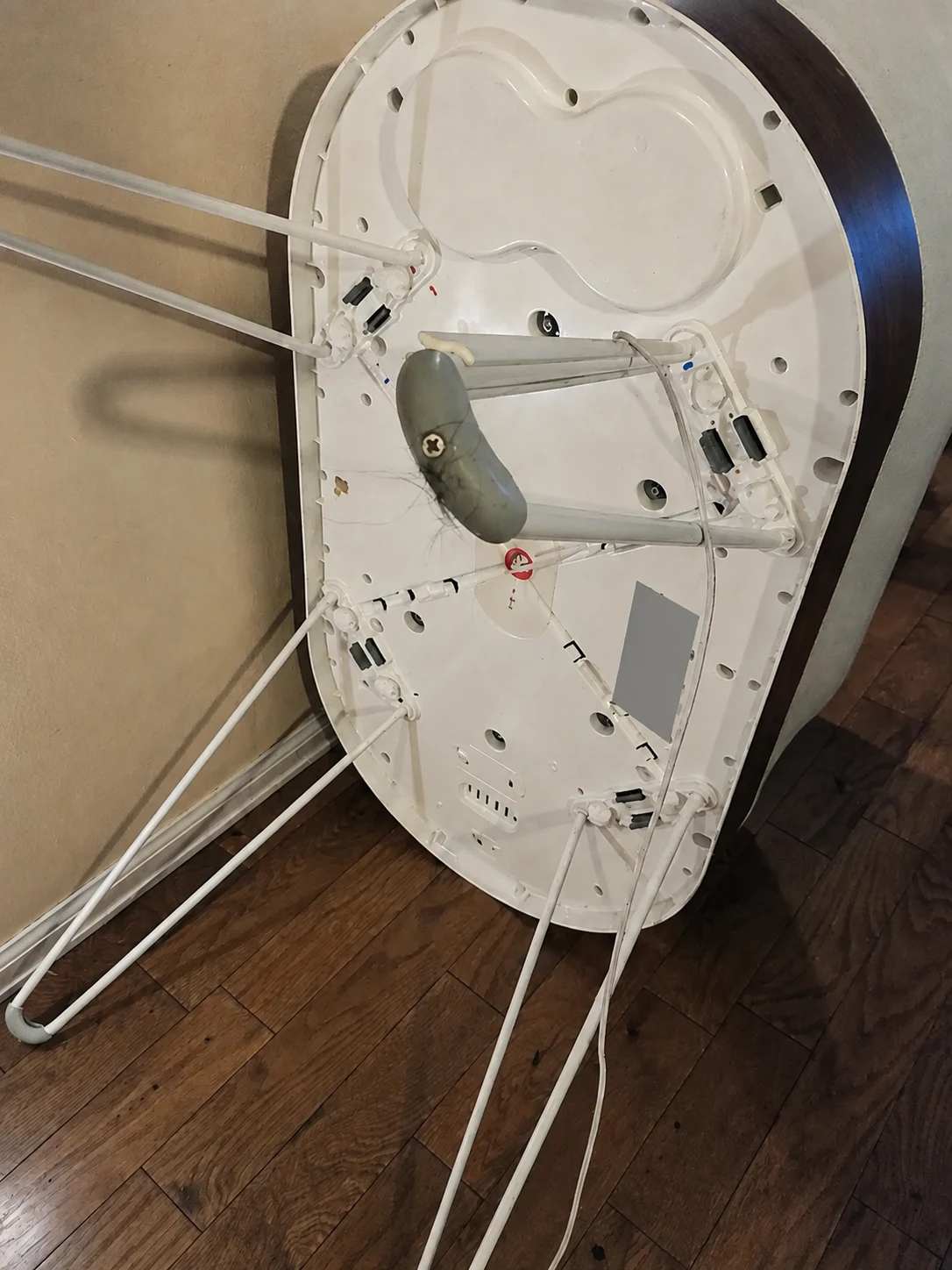
The underside, leg attachments and a gray foot pad.
For more on cable routing and leg attachments, see the used-SNOO inspection section of our rental-vs-buy guide.