
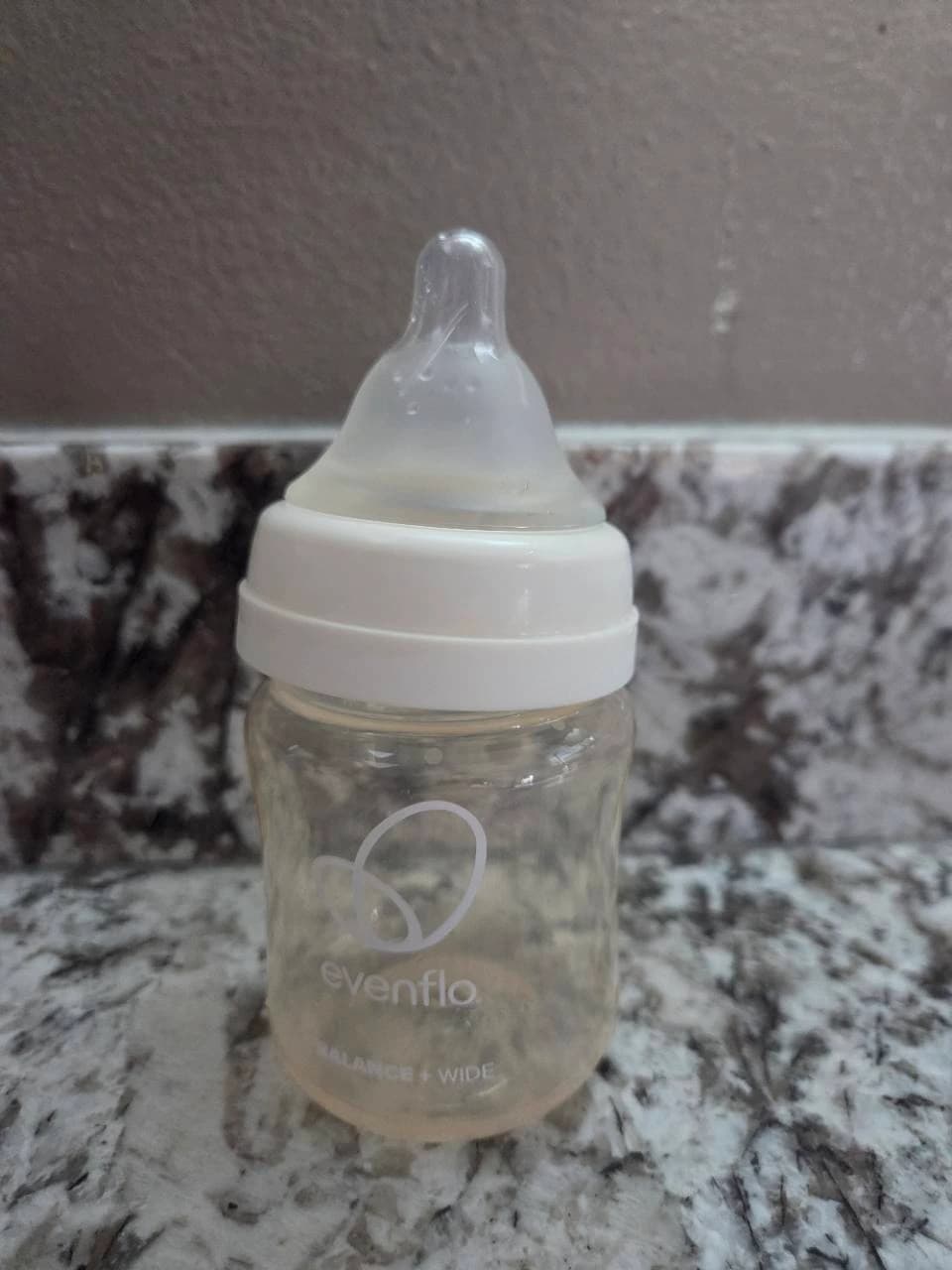
The most confusing thing about an Evenflo bottle nipple is that the marking changes by product family. Balance+, Vented+, and Classic do not all use the same symbols. The second trap is fit: Balance+ Standard and Balance+ Wide are different systems.
Here is the short version from Evenflo's current identification guide:
Evenflo nipple marking guide
Swipe across the table to see every column.
| Evenflo nipple family | Slow | Medium | Fast / special |
|---|---|---|---|
| Balance+ | S | M | X / fast X-cut |
| Vented+ | S + 1 drop | M + 2 drops | X + 4 drops / fast X-cut |
| Classic | 1 on number wheel | 2 on number wheel | 4 on number wheel |
These markings identify a position within that Evenflo family. They do not guarantee the same real-world flow as another brand's slow, medium, or fast nipple.
Where is the Evenflo nipple marking?
Remove the nipple from the cap ring, turn it upside down, and look along the bottom lip or rim. The code can be difficult to see on translucent silicone, so use bright side light and rotate the nipple slowly.
The official Evenflo flow-rate identification guide includes photos for Balance+, Vented+, and Classic. Match the nipple shape and marking together rather than relying on the code alone.
Look around the broad outer rim for the tiny molded lettering. It can be hard to read through the translucent silicone. Turn the nipple slowly in the light until you can make out the flow marking.
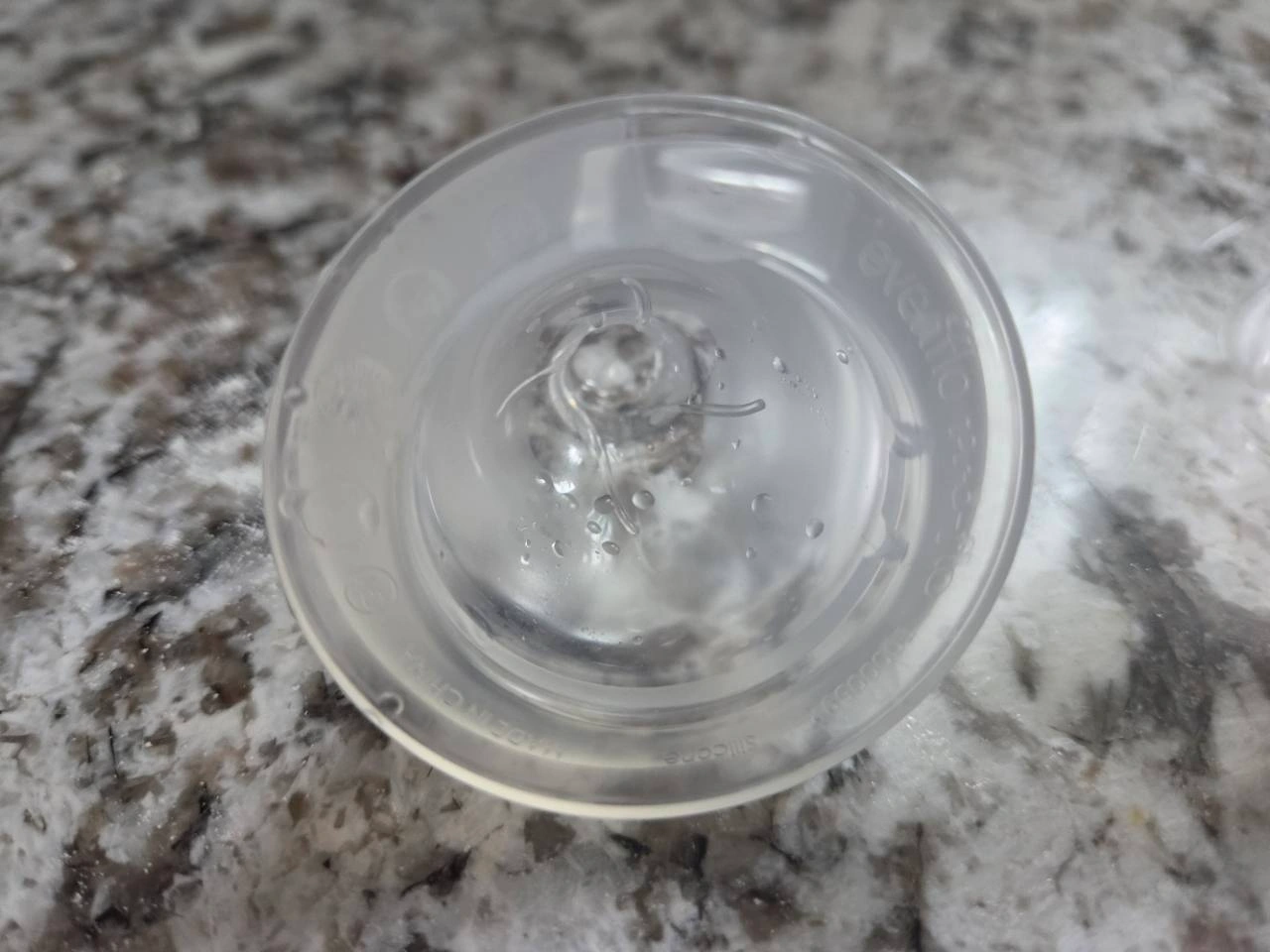
Those tiny markings are tucked around the underside of the rim. Tap for a closer look.
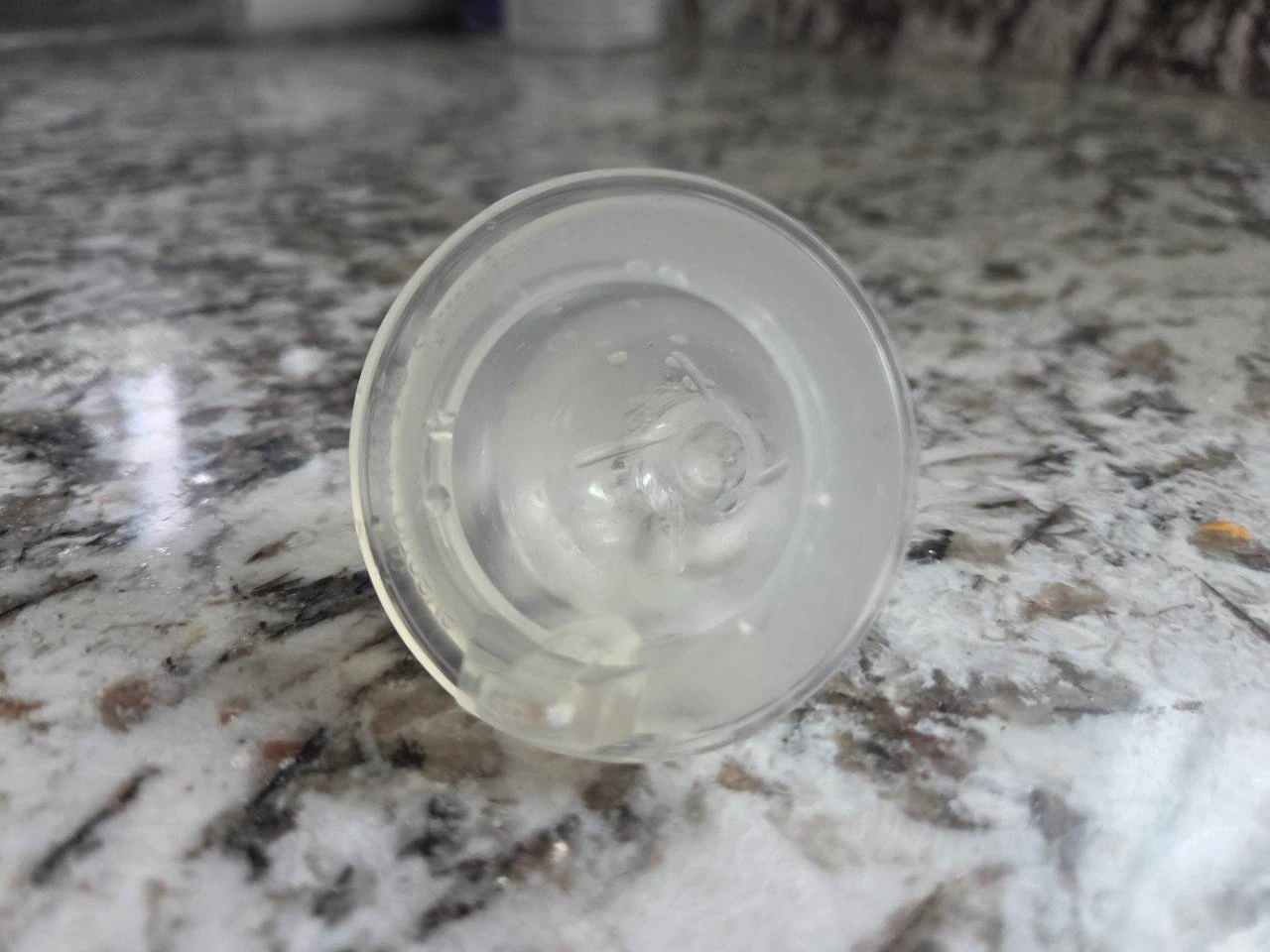
The same spot from a lower angle—the lettering catches the light a little differently.
Evenflo Balance+ slow, medium, and fast flow
S — Slow
Slow is the usual starting point in the Balance+ line. Stay there as long as your baby feeds calmly and effectively. There is no prize for moving to medium on a schedule.
M — Medium
Medium is the next step when slow has become consistently effortful after you have ruled out a clogged opening, sealed vent, incorrect assembly, overtight collar, and temporary tiredness.
X — Fast / X-cut
The X-cut is a specialized faster opening. Do not cut a slow or medium nipple to imitate it. If milk has been medically thickened, ask the prescribing clinician which flow and preparation method to use rather than choosing an X-cut from age alone.
Standard-neck vs. wide-neck compatibility
Evenflo's Balance+ Standard nipple page states that Standard nipples do not fit Balance+ Wide bottles, and Wide nipples do not fit Standard bottles. Use the nipple and collar designed for the same family.
Avoid mixing an Evenflo nipple with another Evenflo cap-ring model just because the diameter seems close. Evenflo says a model mismatch can create venting trouble and nipple collapse.
Approximate starting ages
Unlike brands that print a rigid month for each level, Evenflo's current flow-identification guidance focuses on the flow name and feeding behavior. Treat:
- Slow as the normal starting option
- Medium as a cue-led step up
- Fast/X-cut as a later or specialized option, not an automatic milestone
If feeding has already been complicated for your baby, check with their pediatrician or feeding specialist before moving up a flow.
Signs it may be time to move up
Evenflo's guidance emphasizes behavior, not age. Consider testing the next adjacent flow when several of these happen consistently:
- Feeding takes much longer than usual
- Baby sucks hard but transfers little milk
- Baby becomes frustrated, fussy, or fatigued
- The nipple collapses after fit, vent, assembly, and collar tightness are corrected
Do not move up for one sleepy feed. Read the bottle nipple flow guide and change one variable at a time.
Signs to move back down
The new flow may be too fast if your baby repeatedly gulps, coughs, chokes, leaks milk, pulls away, looks panicked, or struggles to fit breaths between swallows. Return to the previous flow and check the complete cue-based flow guide.
Persistent coughing or choking is a reason to contact your child's clinician, not an invitation to keep experimenting.
Why an Evenflo Balance+ nipple collapses
Evenflo says collapse points to a venting problem. Work through this order:
- Match the parts. Use the same model nipple and cap ring.
- Open the silicone vent. On Balance+, turn the nipple over, find the tiny semicircle at the base, and gently squeeze its slit open before assembly.
- Seat the rim flat. The nipple lip should lie flat against the ring without bunching or pinching.
- Do not overtighten. Tighten only enough to prevent a leak when the bottle is tipped.
- Reassess flow. If assembly and venting are correct, slow may now require too much suction.
See Evenflo's illustrated nipple-collapse checklist and our broader guide to why bottle nipples collapse.
Cleaning and replacement
And then there's the bottle pile waiting at the sink.
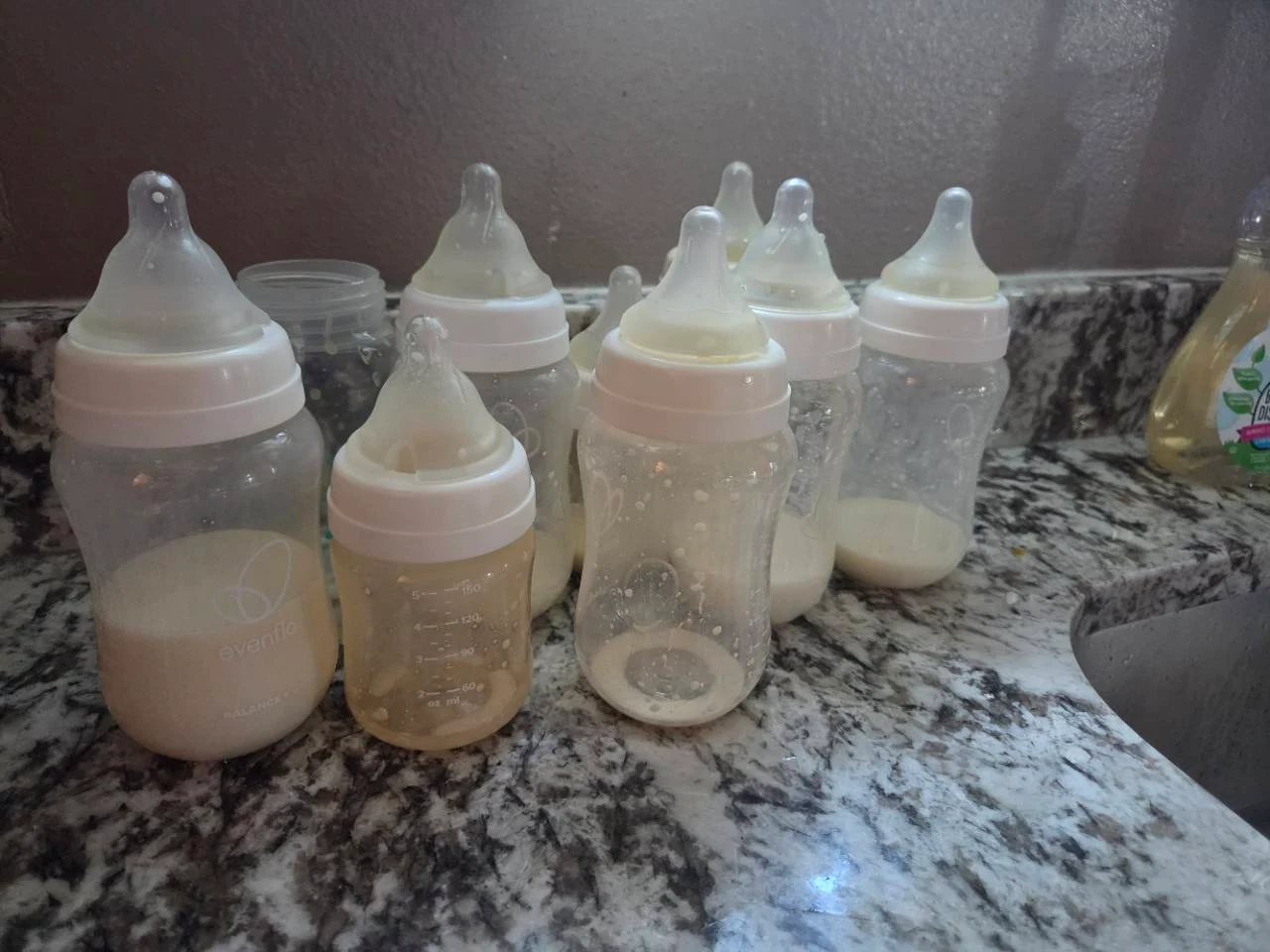
The bottle pile waiting for us at the sink. Yep, all of them need washing.
Separate every piece after each feeding. The CDC advises cleaning bottles, nipples, rings, caps, valves, and membranes after every use, then air-drying completely. Daily sanitizing adds protection for babies under 2 months, babies born prematurely, and babies with weakened immune systems. Follow the current CDC cleaning steps and the Evenflo instructions for your exact bottle.
Inspect silicone before every feed. Replace a nipple with tears, stickiness, swelling, thinning, weakness, discoloration that concerns you, or a damaged opening. Do not enlarge the hole.
Why we moved away from a separate sanitizer
We tried a separate bottle sanitizer, but it was bulky and kind of annoying. Moving the bottle-cleaning routine to the dishwasher worked better for our household. We used a metal colander to keep the little nipples together—here is the actual setup we tried.
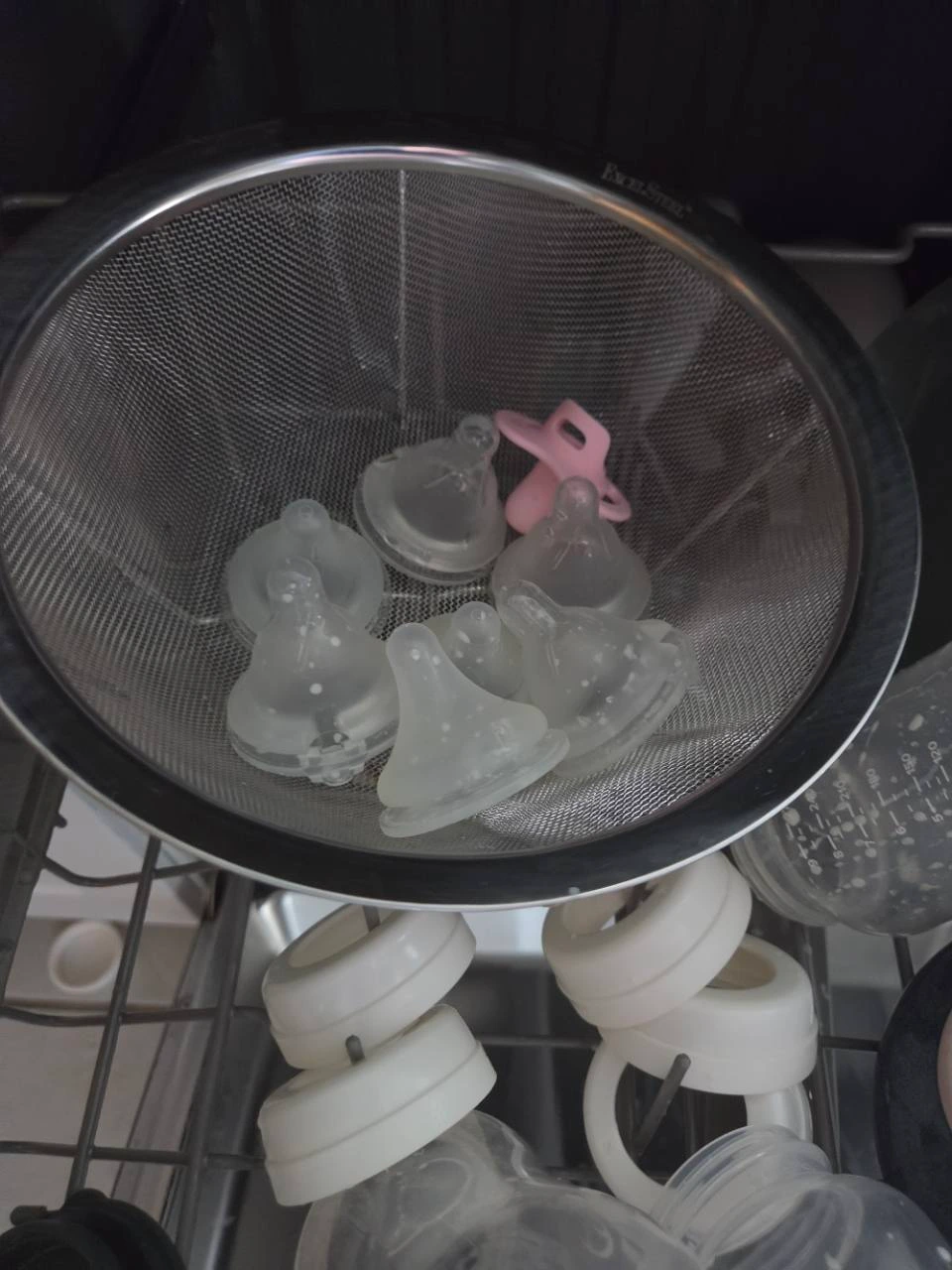
Our colander experiment: keeping all those little nipples together in the dishwasher.
One thing we'd change: use a container that closes. The CDC recommends a closed-top basket or mesh laundry bag to keep small parts from getting loose. Our open colander doesn't do that. Check that the feeding parts and container are dishwasher-safe, and separate and rinse the parts before loading them.
The CDC says a separate sanitizing step is unnecessary when dishwasher cleaning uses hot water and a heated drying cycle (or a sanitizing setting). Do not assume a normal wash without those conditions is equivalent. Let anything still damp air-dry completely before storage. Source checked September 7, 2026.
Compare Evenflo with other bottle systems
- 10-brand baby bottle nipple flow chart
- Philips Avent nipple sizes
- Dr. Brown’s nipple levels
- MAM nipple size chart
- Lansinoh nipple flow rates
This article is general education, not medical advice. Get urgent help for severe breathing trouble, blue/gray color, limpness, or unresponsiveness.