
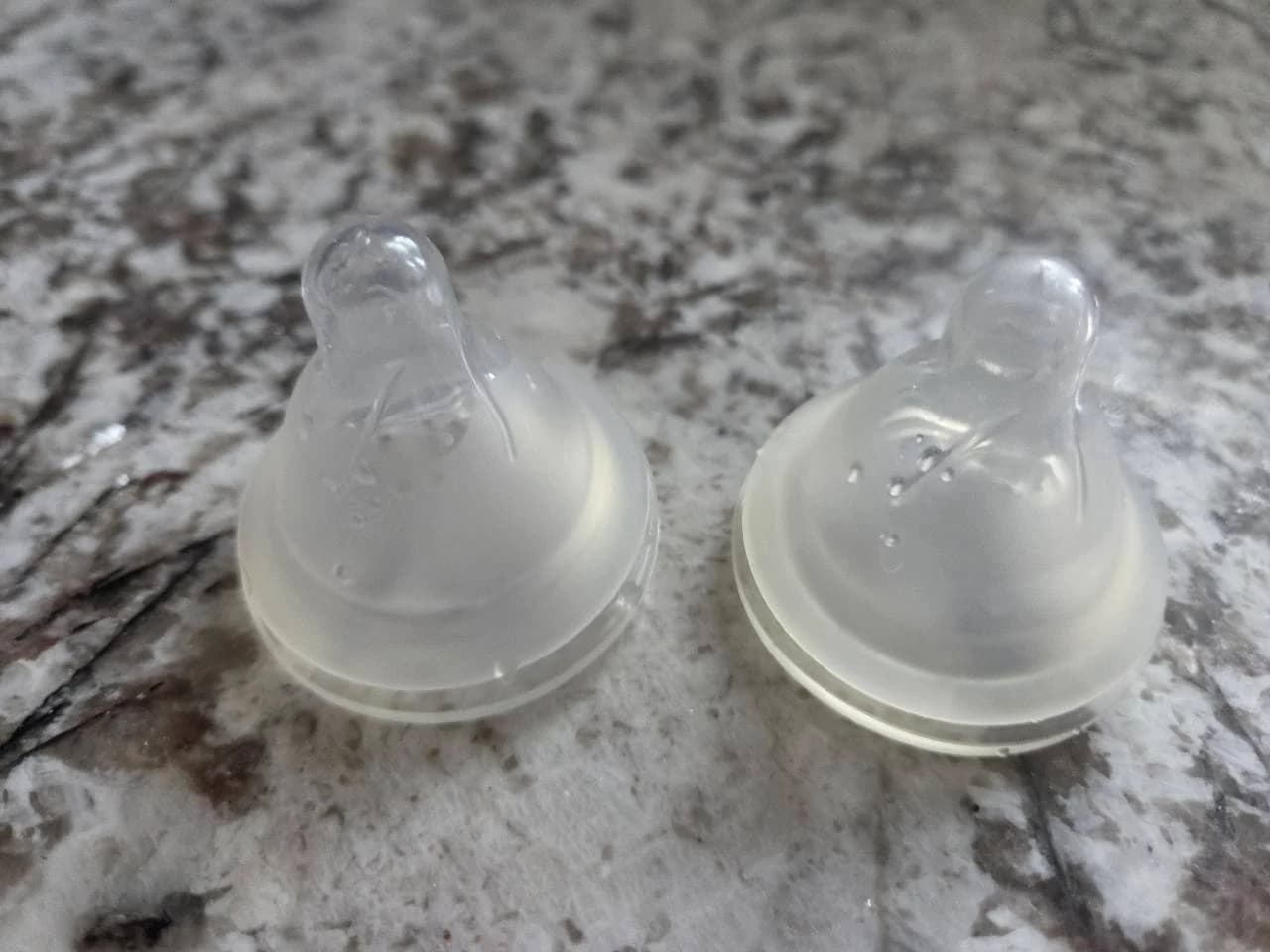
Bottle nipple sizes are maddening because there is no universal standard. A “Level 1,” “slow,” or “newborn” nipple from one brand can flow differently from another brand with the same label. Shape, hole style, silicone stiffness, venting, liquid thickness, and your baby's suction all affect the real flow.
This baby bottle nipple size chart puts the manufacturer systems in one place. Use age ranges only as starting points. A calm, coordinated feed matters more than the birthday printed on a package.
Quick rule: Stay with the current nipple while your baby feeds comfortably, breathes easily, and finishes without persistent frustration. Try slower for gulping, coughing, leaking, or overwhelmed behavior. Consider faster for consistently long, effortful feeds or frustration—but first check assembly, clogs, and venting.
Bottle nipple flow chart by brand
Manufacturer information was checked on August 23, 2026. Product lines change, so match the exact bottle family and current package before buying replacements.
Baby bottle nipple flow systems at a glance
Swipe across the table to see every column.
| Brand / system | Slowest and early flows | Middle flows | Faster / special flows | Manufacturer age guide* |
|---|---|---|---|---|
| Evenflo Balance+ | S / slow | M / medium | X / fast or X-cut | Cue-led; no rigid age progression in the current identification guide |
| Philips Avent Natural Response | Flow 1; optional First Flow 0 | Flows 2–3 | Flows 4–5 in the US/Canada | Philips says follow feeding cues, not age alone |
| Dr. Brown’s | Ultra-Preemie, Preemie, then T | Levels 1 (0m+), 2 (3m+), 3 (6m+) | Level 4 (9m+), Y-cut (9m+, thicker liquids) | Ages are starting guides, not deadlines |
| MAM | Size 0 extra slow (0m), 1 slow (0m+) | Size 2 medium (2m+) | Size 3 fast (4m+), X thick liquids (6m+) | MAM says the guide may vary by drinking pattern |
| Lansinoh NaturalWave | Extra-slow; 2S slow | 3M medium | 4L fast | Lansinoh says there is no exact switching age |
| Tommee Tippee Natural Start | 0 extra slow; 1 slow (0m+) | 2 medium (3m+) | 3 fast (6m+); X vari-flow | Every baby is unique; ages are a guide |
| Comotomo | 1 hole / slow (0–3m) | 2 holes / medium (3m+) | 3 holes / fast (6m+); Y-cut variable (6m+) | Manufacturer starting ages shown |
| Pigeon SofTouch | SS round hole (0m+), S round hole (1m+) | M Y-cut (3m+) | L Y-cut (6m+), LL Y-cut (9m+) | Manufacturer starting ages shown |
| NUK | Slow (0m+) | Medium (0m+ or 1m+, depending on line) | Fast (6m+) | Exact system and package control the answer |
| Nanobébé | P preemie; 1 slow (0–3m) | 2 medium (3–6m) | 3 fast (6m+); Y-cut for thicker formula | Manufacturer starting ages shown |
*Age is an approximate manufacturer starting point, never proof that your baby should move up. Premature babies and babies with feeding, airway, cardiac, neurologic, or growth concerns need individualized guidance.
The systems are not interchangeable
Do not translate “Avent Flow 3” into “Dr. Brown’s Level 3.” The numbers belong only to that brand's own lineup. Even within one brand, narrow and wide-neck parts may use different shapes or fit rules.
Also do not assume a nipple fits because it can be pushed into another brand's collar. A mismatched nipple and ring can leak or vent incorrectly. Evenflo specifically warns that mixing nipple and cap-ring models can contribute to collapse. Use the nipple designed for the exact bottle system unless both manufacturers explicitly confirm compatibility.
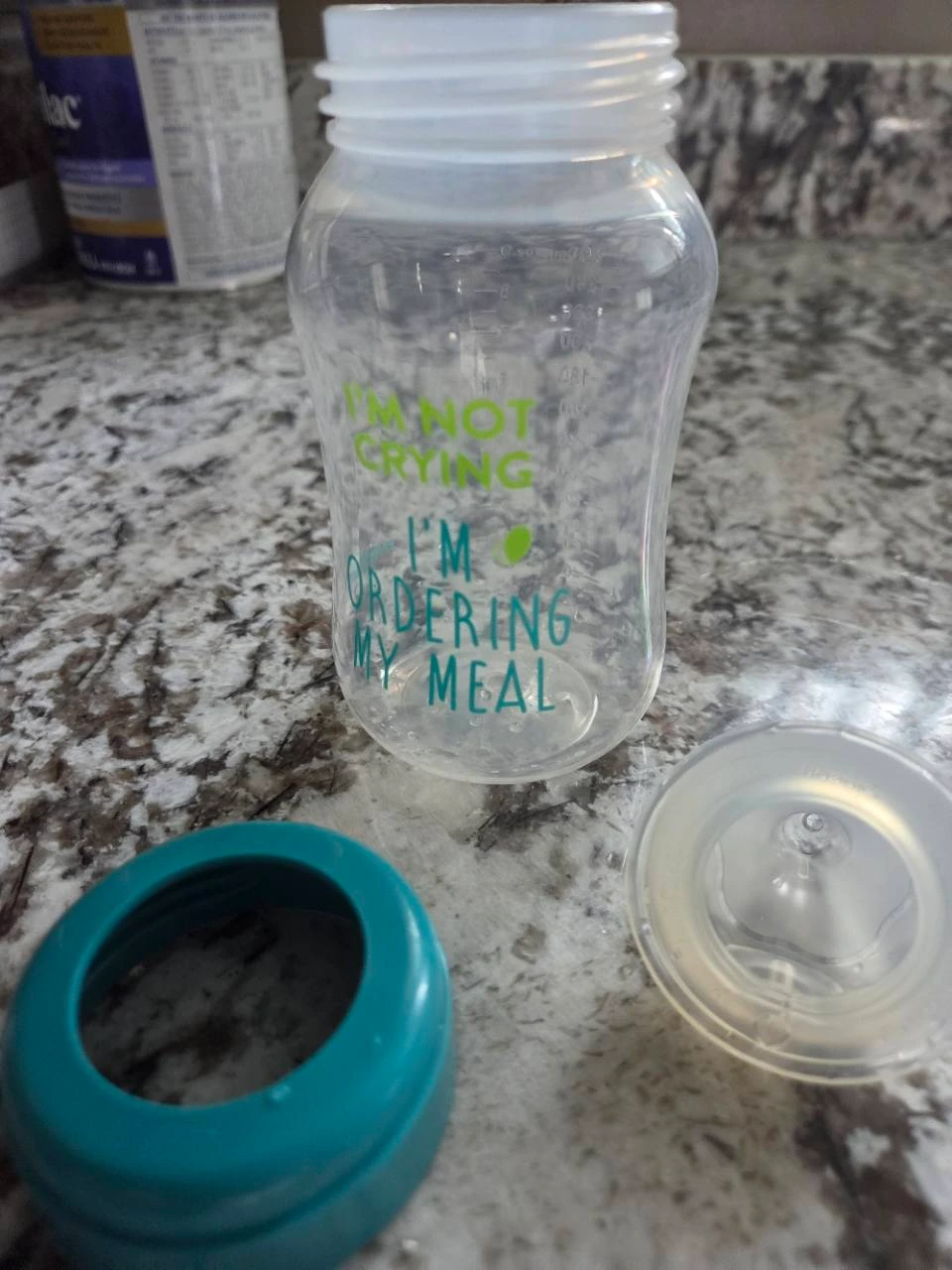
Bottle, collar and nipple, taken apart. “I'm not crying, I'm ordering my meal” still makes us laugh.
How to tell whether the flow is right
A workable flow lets your baby coordinate sucking, swallowing, and breathing without looking flooded or exhausted. Watch the whole feed, not a single noisy swallow.
Signs the nipple may be too fast
- Repeated gulping, coughing, choking, or hard swallows
- Milk spilling from the corners of the mouth or pooling under the chin
- Pulling away, wide eyes, stiffening, or frantic pauses
- Clicking with loss of latch
- Breathlessness or difficulty fitting breaths between swallows
Start with our complete bottle nipple flow guide. A slower flow can help, but recurring coughing or choking deserves a call to your pediatrician or feeding specialist.
Signs the nipple may be too slow
- Feeds regularly stretch past roughly 30 minutes
- Strong sucking with little milk transfer
- Nipple repeatedly collapses after assembly and venting are checked
- Frustration, crying, biting, or batting the bottle away
- Falling asleep from effort before taking a typical feed
Read the bottle nipple flow guide before jumping up. A clogged hole, sealed vent, overtight collar, poor latch, or tired baby can look like a slow-flow problem.
Brand-by-brand details
Evenflo Balance+
Remove the nipple from the cap ring and look at the bottom lip. Evenflo identifies Balance+ with S for slow, M for medium, and X for fast/X-cut. Vented+ uses a letter plus drop icons, while Classic uses a numbered wheel, so confirm which family you own. Standard-neck Balance+ nipples do not fit Balance+ Wide bottles and vice versa. See the complete Evenflo bottle nipple size and marking guide.
Philips Avent Natural Response
Natural Response nipples release milk when a baby actively drinks and pause when the baby pauses. In the US and Canada, Philips lists flows 1 through 5 and also offers a First Flow 0. Philips explicitly says babies do not need a higher flow simply because they get older. See the Philips Avent nipple flow chart.
Dr. Brown’s
Dr. Brown’s has the deepest named progression: Ultra-Preemie, Preemie, Level T, then Levels 1 through 4 and Y-cut. Level T sits between Preemie and Level 1. Narrow and wide-neck nipples must match their bottle style. See the Dr. Brown’s nipple level chart.
MAM
Current MAM instructions show 0 extra slow, 1 slow, 2 medium, 3 fast, and X for thicker liquids. The air valve is designed to help prevent nipple collapse. See the MAM nipple size chart.
Lansinoh NaturalWave
Lansinoh sells extra-slow, slow, medium, and fast. The flow code appears on the bottom rim: 2S, 3M, or 4L for the three primary flows. Lansinoh says to watch feeding behavior rather than switch at an exact age. See the Lansinoh nipple flow guide.
Tommee Tippee, Comotomo, Pigeon, NUK, and Nanobébé
These systems remain in this hub until the site has enough reader demand for separate guides. Check the live manufacturer references before ordering:
- Tommee Tippee Natural Start nipple flows
- Comotomo replacement nipple flows
- Pigeon milk-flow research and SofTouch sizes
- NUK bottle flow FAQ
- Nanobébé nipple flow options
Never enlarge a nipple hole yourself
Do not cut, poke, or stretch a nipple hole to speed it up. That creates an uncontrolled flow and can damage the silicone. Y-cut or thick-liquid nipples should be used only as the product instructions allow. If a clinician recommends thickening milk, ask exactly which nipple, recipe, and feeding plan to use—especially for premature or medically complex babies.
A simple way to change flows
- Check that every part is clean, undamaged, correctly seated, and from the same bottle system.
- Open or align the vent exactly as the manufacturer instructs.
- Try one adjacent flow, not a multi-level jump.
- Use the same milk and a familiar feeding position for a fair comparison.
- Watch coordination, comfort, leakage, effort, and feed duration.
- Move back if the new flow causes gulping, coughing, leaking, or stress.
The goal is not the fastest bottle. It is a comfortable, responsive feed your baby can coordinate.
Keeping track of all those little parts
Our bottle-parts cabinet gives you an idea of the real-life sorting involved: bottle bodies, collars, caps and nipples all end up in the same small space. Keep the matching bottle systems together rather than assuming similar-looking parts are interchangeable.
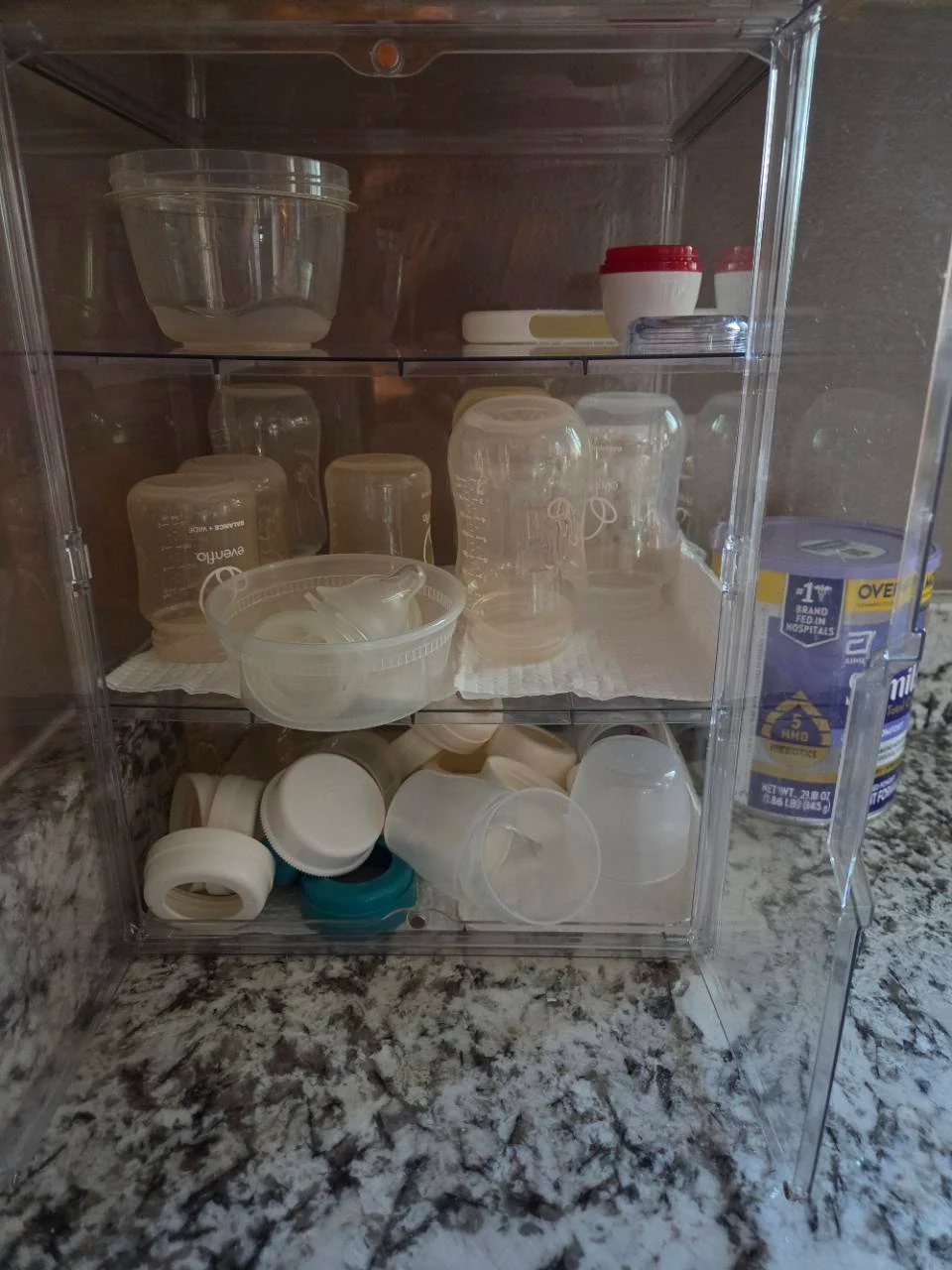
Our bottle cabinet. Somehow there are always more little pieces to keep track of.
For the actual cleaning and storage routine, the CDC recommends letting washed parts air-dry completely before reassembling with clean hands and placing them in a clean, protected area. A cabinet does not replace washing or sanitizing when needed. Cleaning/storage source checked September 7, 2026; the chart's manufacturer-check date remains listed above.
Complete bottle-flow guide library
- Bottle nipple flow guide: when to size up or slow down
- Why a bottle nipple collapses
- Responsive paced bottle feeding
For feeding technique, the CDC recommends holding the bottle at an angle so milk comes out when the baby sucks, allowing breaks, and stopping at fullness cues. Never prop a bottle or force a baby to finish. See the current CDC bottle-feeding guidance.
This guide is general education, not medical advice. If your baby repeatedly coughs or chokes, struggles to breathe, changes color, feeds poorly, or is not growing as expected, contact a pediatric clinician. Call emergency services for severe breathing trouble, blue/gray color, limpness, or unresponsiveness.