
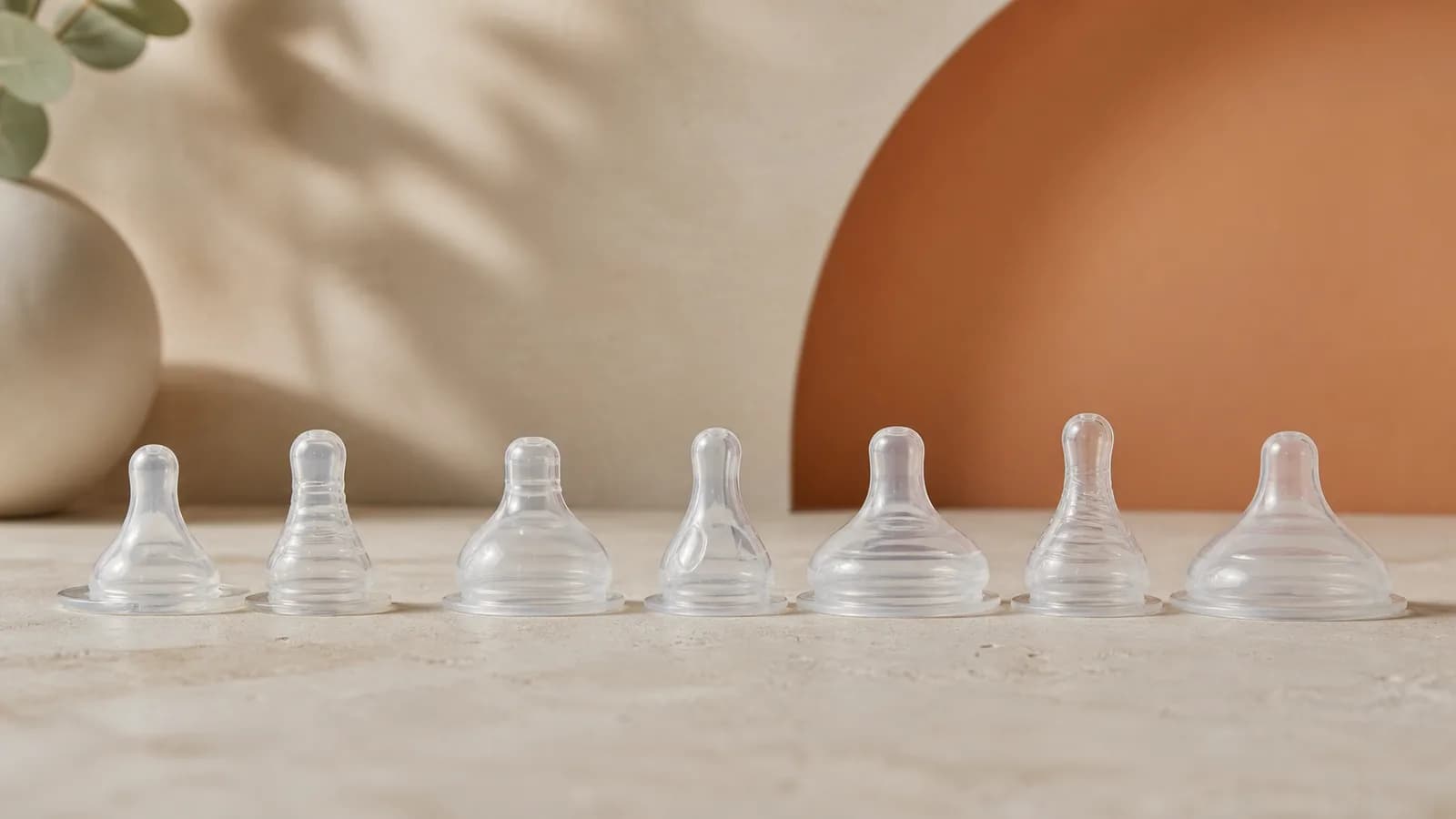
The Dr. Brown’s nipple level order has two steps many quick charts leave out: Ultra-Preemie and Level T. Level T sits between Preemie and Level 1, giving some newborns and babies with feeding difficulties a smaller jump.
Dr. Brown’s nipple size chart
Dr. Brown’s nipple level chart
Swipe across the table to see every column.
| Nipple | Manufacturer age guide | What Dr. Brown’s says it is for |
|---|---|---|
| Ultra-Preemie | 0m+ / medical slowest flow | Premature or medically fragile babies needing the lowest flow; typically used with professional guidance |
| Preemie | 0m+ | Premature babies, slower feeding preference, or a slower breast-to-bottle flow |
| Level T | 0m+ | Faster than Preemie but slower than Level 1; a gradual transition option |
| Level 1 | 0m+ | Standard starting nipple included with most bottles |
| Level 2 | 3m+ | Next flow when Level 1 has become consistently slow |
| Level 3 | 6m+ | Later flow for babies who handle Level 2 comfortably but need faster transfer |
| Level 4 | 9m+ | Faster later-stage flow for coordinated feeders |
| Y-Cut | 9m+ | Thicker liquids when recommended by a pediatrician |
These are manufacturer starting points. Dr. Brown’s explicitly says there is no single right time to change levels. Some babies remain comfortable on Level 1 throughout bottle feeding; others need a different pace.
The difference between Preemie, T, and Level 1
The order is:
Ultra-Preemie → Preemie → Level T → Level 1
Level T is not shorthand for “thick.” It is a transition flow between Preemie and Level 1. Dr. Brown’s says its T nipple may suit some newborns, breastfed babies, and babies with feeding difficulties. Its Level T product guidance confirms that relative order.
Ultra-Preemie and other medical feeding decisions should be made with the infant's care team. Slower is not automatically safer if a baby tires, cannot transfer enough milk, or has a specific swallowing plan.
Signs it may be time to move up
Dr. Brown’s lists these common too-slow signs:
- Taking longer to finish feeds
- Becoming fussy or irritated while eating
- Falling asleep during feeding
Before changing the level, clean the nipple opening, assemble the internal vent correctly, confirm the bottle and nipple style match, and consider whether the behavior happens across multiple feeds.
Signs the level may be too fast
Dr. Brown’s recommends considering a lower flow for:
- Gulping or hard swallowing
- Coughing or choking
- Milk dripping from the mouth
- Refusing or pulling away from the bottle
Return to the previous level if a step up creates these signs. Repeated cough, choke, breathing changes, or poor growth needs a pediatric or feeding evaluation.
The full manufacturer explanations are in the official Dr. Brown’s nipple level guide.
Narrow vs. wide-neck fit
Dr. Brown’s makes narrow and wide-neck nipples. Match the replacement nipple to the bottle style shown on the package. A narrow Level T nipple fits narrow bottles; a wide-neck Level T fits the wide-neck system. The flow name does not override the physical fit.
Dr. Brown’s also says the internal vent system should always be used with Preemie and Level T nipples. Follow the exact instructions that came with your bottle.
What about thickened milk?
Dr. Brown’s describes Y-cut as an option for thicker liquids and says to consider it when a pediatrician recommends thickening. Do not add cereal or another thickener, change the recipe, or cut a nipple opening on your own. Thickening changes flow and can be part of a medical feeding plan.
Ask the clinician:
- Which liquid and exact thickness?
- Which nipple family and level?
- Whether the internal vent stays in place?
- What coughing, fatigue, or intake signs should trigger a call?
How to test a new Dr. Brown’s level
Move only one step unless your feeding team directs otherwise. Observe a full familiar feed. A good flow supports steady sucking with room to breathe, little leakage, and no repeated stress. A faster finish is not better if coordination gets worse.
For technique, see responsive paced bottle feeding. For a wider comparison, use the 10-brand bottle nipple chart.
Related flow guides
This guide is general education, not medical advice. Get urgent help for severe breathing trouble, blue/gray color, limpness, or unresponsiveness.