
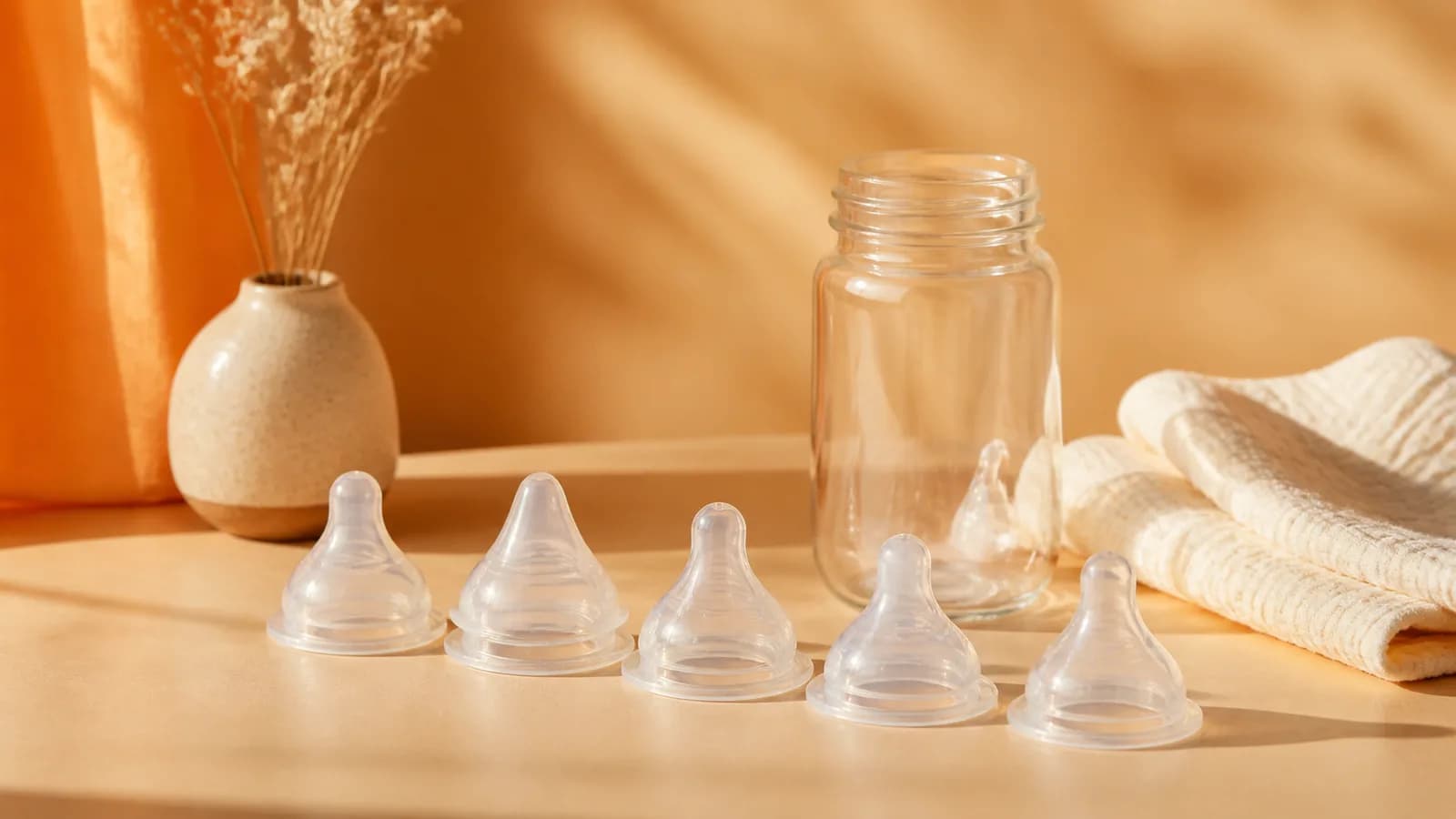
The important thing about Philips Avent nipple sizes is that Natural Response is not meant to drip continuously like a traditional free-flow nipple. Its valve releases milk when baby actively drinks and pauses when baby pauses.
That design is why Philips tells parents to choose a flow by feeding cues, not age alone.
Philips Avent Natural Response flow chart
Philips Avent Natural Response flow chart
Swipe across the table to see every column.
| Flow | Where it sits in the lineup | Practical starting point |
|---|---|---|
| 0 First Flow | Slowest optional Natural Response flow | Some newborns or babies needing a very gentle start |
| 1 | Slow standard flow | Early bottle feeds when baby transfers comfortably |
| 2 | Slow-to-middle | If Flow 1 is consistently too much work |
| 3 | Middle | Common step when lower flows cause long, frustrating feeds |
| 4 | Faster | Only when baby remains coordinated and lower flows are too slow |
| 5 | Fastest commonly listed US/Canada flow | For babies who clearly need faster flow, not an automatic age milestone |
Philips notes that available flows vary by country; the US/Canada guidance lists 1–5 and the First Flow 0 product. Match the current package and nipple family.
Do Avent nipples change by age?
Not automatically. Philips says you do not need to change to a higher flow as your baby gets older if your baby is calm, comfortable, and getting enough milk.
Consider a higher flow when:
- Baby is not taking enough during otherwise typical feeds
- Feeds routinely exceed about 30 minutes
- Baby falls asleep, gets frustrated, or plays with the nipple instead of transferring milk
Consider a lower flow when:
- Baby gulps
- Milk leaks from the mouth
- Baby looks overwhelmed or repeatedly breaks the latch
Those are Philips' own examples in its Natural Response flow guidance. Recurring cough, choke, breathing difficulty, or poor growth needs professional evaluation.
Older Avent Natural to Natural Response conversion
If you are moving from the older Natural nipple, Philips provides this loose starting comparison:
Older Avent Natural to Natural Response starting comparison
| Older Natural nipple | Natural Response starting point |
|---|---|
| Flow 0 | Flow 2 |
| Flow 1 | Flow 3 |
| Flow 2 | Flow 4 |
| Flow 3 | Flow 5 |
| Flow 4 | Flow 5 |
This is not a promise of identical measured flow. Watch the first full feed and adjust by your baby's response. Philips' current nipple transition page also says the age icons are indicators only.
Natural Response vs. Anti-colic nipples
“Philips Avent” is a brand, not one universal nipple system. Natural Response and Anti-colic bottles use different parts and flow behavior. Confirm the product family on the bottle, collar, nipple package, and instructions. Do not pick a level from this chart for a different Avent system.
A low-stress way to find the right flow
- Start with the current nipple if feeds are comfortable.
- Confirm the valve and collar are assembled as instructed and the opening is clean.
- If feeds are consistently too slow, test one adjacent flow up.
- Keep the milk, caregiver, and position familiar during the comparison.
- Move back down for gulping, leaking, coughing, or stress.
Natural Response may require an adjustment period for a baby used to milk dripping without active drinking. A refusal on the first attempt does not always prove the flow is wrong.
Replacement and safety
Philips advises replacing nipples about every three months for hygiene and inspecting before every use. Discard at the first sign of damage or weakness. Clean every bottle part after each feed using the product instructions and current CDC bottle-cleaning guidance.
Never cut or enlarge an opening. Do not use a faster flow to solve repeated coughing or choking without talking to your pediatrician or feeding specialist.
Keep comparing
- 10-brand bottle nipple size chart
- Bottle nipple flow guide: when to size up or slow down
- Responsive paced bottle feeding
This guide is educational and does not replace individualized feeding advice.