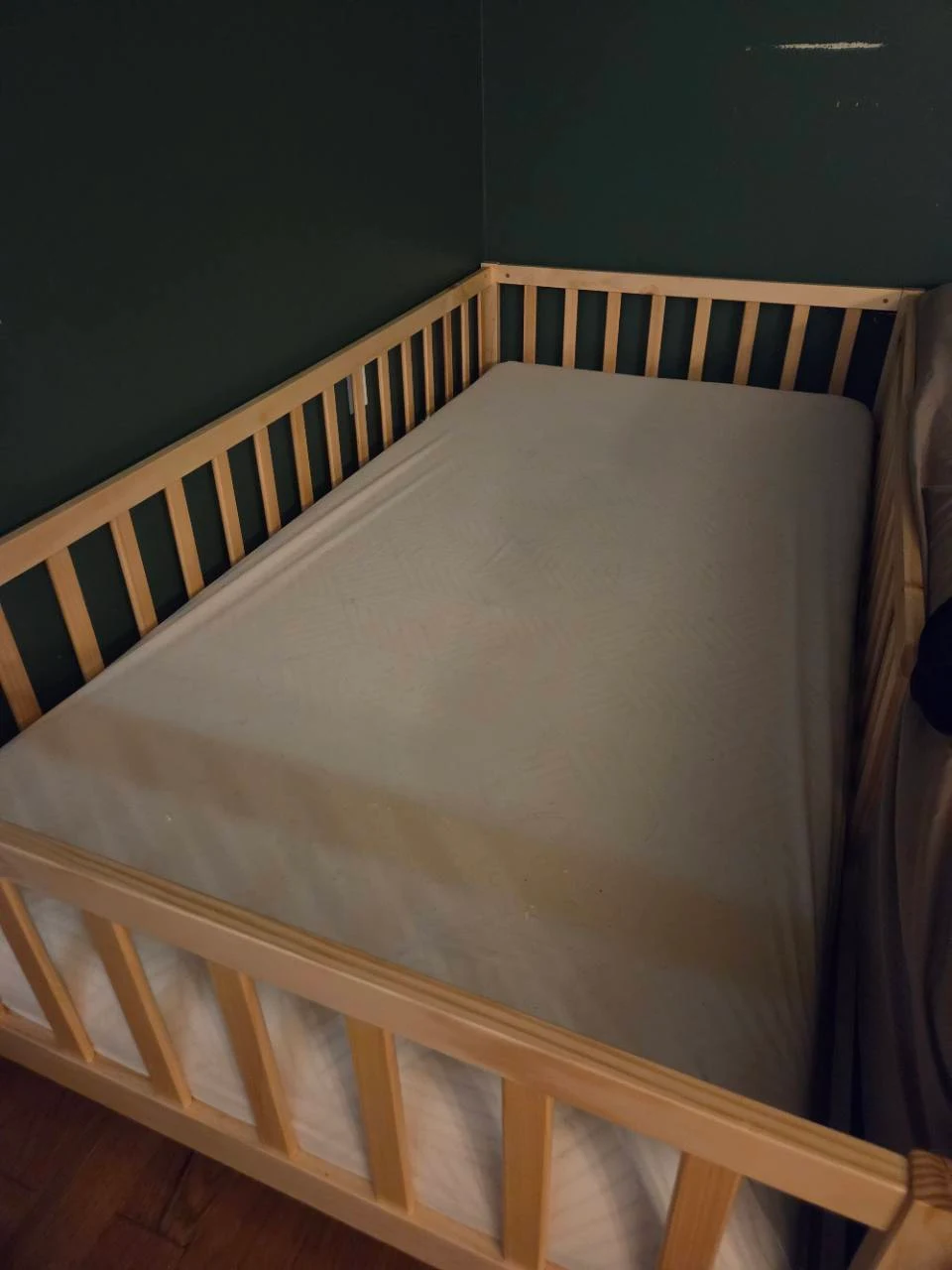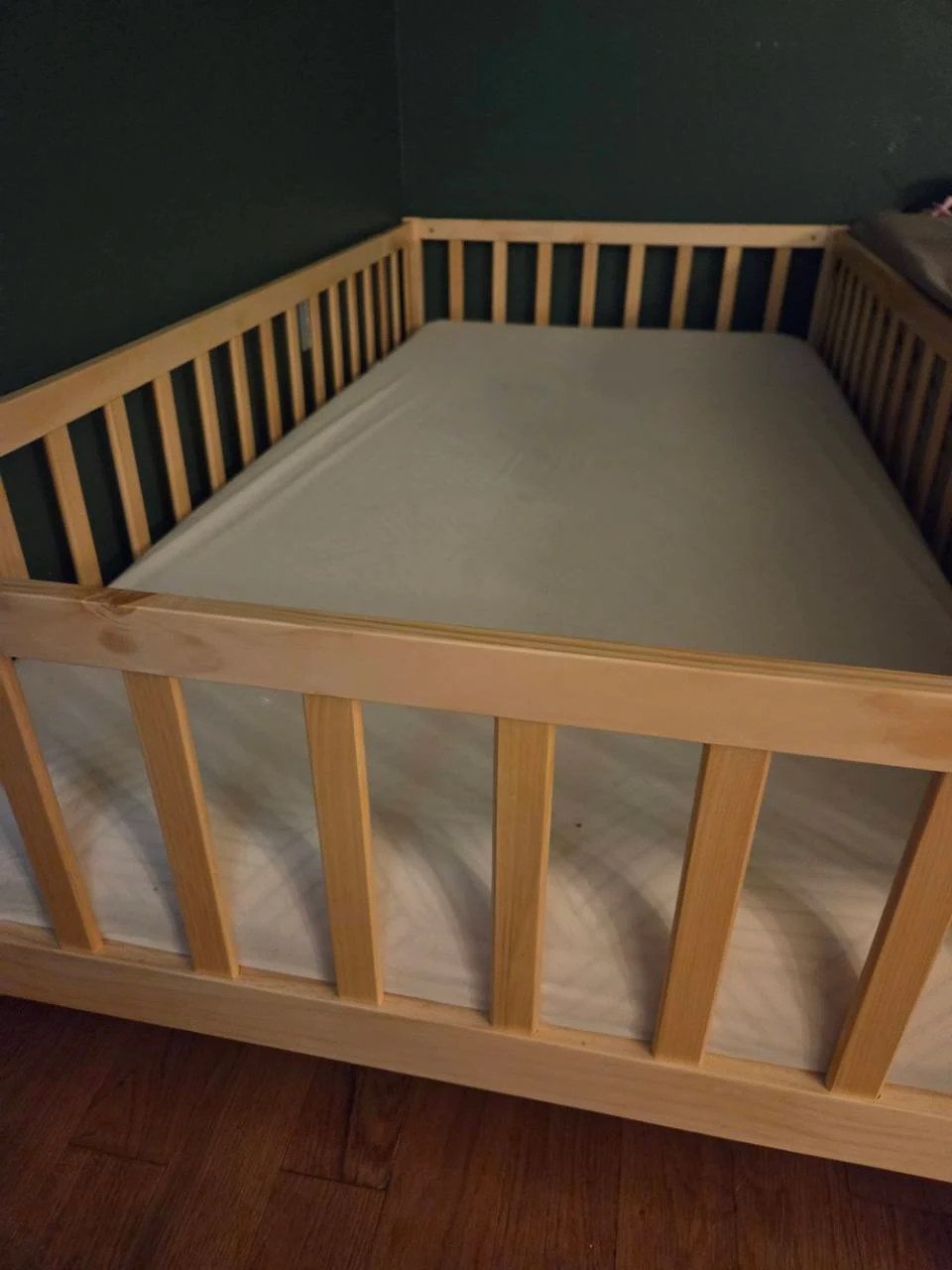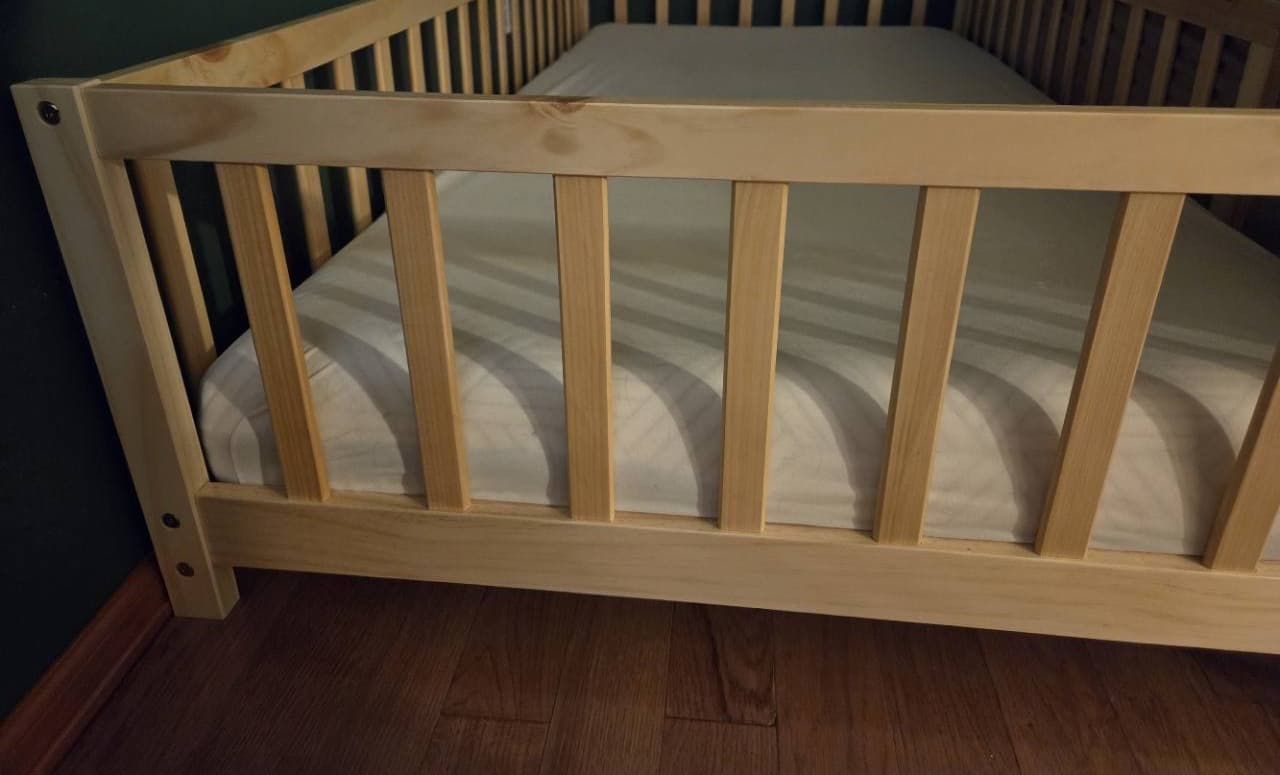
A Montessori floor bed is a low, child-accessible sleep space intended to let a mobile child get in and out independently. It may be a simple mattress on a manufacturer-approved base, a low platform, or a wood frame with partial sides.
The appealing part is not the house-shaped frame in a product photo. It is the idea that the room and routine are arranged around the child's size, movement, and growing independence.
The important limit: “Montessori bed” is not a government safety category. The name does not tell you the child's minimum age, the mattress fit, whether rails were tested with the frame, or whether the product meets the federal toddler-bed standard. Those details must come from the exact product label and instructions.
Short answer: A floor bed can be a practical crib-transition option for a ready toddler. For a baby under one, the AAP recommends a CPSC-compliant crib, bassinet, portable crib, or play yard—not an ordinary adult or toddler mattress placed on the floor.
What makes a floor bed “Montessori”?
In a Montessori-inspired room, useful objects are visible and reachable, movement is encouraged, and the environment is prepared instead of relying on constant adult correction. Applied to sleep, that usually means:
- a sleep surface close to the floor;
- a clear path in and out of bed;
- a small number of accessible books or quiet activities;
- child-height storage that is securely anchored;
- a calm, uncluttered layout; and
- a completely childproofed room.
You do not need a roof, picket fence, canopy, or expensive specialty frame. Those are style choices. A low bed that fits correctly and a thoughtfully prepared room matter more.
When can a child use a Montessori floor bed?
There is no single age for every floor bed. Product category, child development, and manufacturer instructions all matter.
Age guide for common low-bed setups
| Age / stage | What to know | Practical direction |
|---|---|---|
| Under 12 months | AAP infant safe-sleep guidance applies | Use a compliant crib, bassinet, portable crib, or play yard with a firm flat mattress and fitted sheet |
| 12–15 months | Still below the minimum age for the federal toddler-bed category | Do not assume a low adult mattress is appropriate; follow the pediatrician and exact sleep-product instructions |
| 15 months+ | Federally regulated toddler beds are intended for children at least 15 months old and no more than 50 pounds | A labeled toddler bed with a full-size crib mattress may be an option |
| About 2 years+ | Some twin Montessori beds begin at 24 months; portable rails are typically for ages 2–5 on adult beds | Use only the frame, mattress and rail combination the maker permits |
| Ready big-bed child | Can get in and out independently and remain safe in a fully childproofed room | A low open twin or full frame may work if its instructions fit the child |
CPSC defines a toddler bed as one using a full-size crib mattress for a child at least 15 months old and no more than 50 pounds. Twin and full floor beds are generally kids' beds, not regulated toddler beds, and may set different minimum ages.
Read Are Floor Beds Safe for Babies? for the infant-specific answer.
Potential benefits—and what they do not prove
Easier independent access
A low surface lets a mobile toddler climb into bed without being lifted over a crib rail. In the morning, they can reach a safe book or quiet toy while waiting for a caregiver.
That independence may reduce power struggles for some families. It does not guarantee better sleep, earlier development, or a calmer toddler.
A shorter roll to the floor
A true floor-level surface reduces the vertical distance of a roll-out compared with a standard bed. This is different from eliminating risk. Hard objects, gaps, cords, windows, heaters, and badly attached rails can still cause injury.
Longer-lasting sizes
A twin or full frame can last years longer than a crib-mattress toddler bed. The tradeoffs are a larger footprint, higher mattress cost, and more opportunities for the wrong mattress thickness or room placement.
A room designed for the child
The biggest practical benefit may be the setup discipline: anchored furniture, fewer hazards, accessible books, and a predictable bedtime environment are useful with any bed.
Choose the bed before the mattress
Start with the frame instructions. Confirm:
- minimum age and maximum weight;
- exact mattress length and width;
- allowed mattress-thickness range;
- slat or foundation requirements;
- approved rail configuration;
- clearance from walls and other furniture; and
- recall and product-registration information.
A standard full-size crib mattress is roughly 27¼ by 51⅝ inches. A standard US twin is about 38 by 75 inches, and a full is about 54 by 75 inches. “Standard” is not a substitute for measuring the exact frame and reading its manual.
If a rail is present, a thicker mattress can leave too little rail above the sleep surface. A mattress that is too narrow can leave an entrapment gap. Our floor-bed mattress guide walks through fit, support, moisture, and protectors.
Rails, sides, or an open frame?
Partial built-in sides can provide a visual boundary and reduce short roll-outs. Open frames make the exit obvious and avoid creating a crib-like enclosure around a child who can climb.
Neither approach wins automatically. Look at the exact openings between:
- mattress and frame;
- mattress and rail;
- rail and headboard;
- bed and wall; and
- bed and nearby furniture.
Portable bed rails have their own federal standard. CPSC says they are typically intended for children ages two to five who can get in and out of an adult bed without help. Their required warnings say not to use them for children under two, as a crib substitute, or on a toddler bed unless the product is specifically designed and instructed for that use.
Use the full rails vs. no-rails decision guide before adding an aftermarket rail.
Prepare the entire room
Once the crib rails are gone, the room effectively becomes the sleep enclosure. Get down at child height and inspect every reachable surface.
Anchor and remove climbable hazards
Anchor dressers, bookcases, televisions, and freestanding storage to the wall with the correct hardware. Keep heavy items low. Remove unstable stools, floor lamps, toy chests with unsafe lids, and furniture that creates access to windows.
Control windows and cords
Place the bed away from windows. Install appropriate window guards or stops, keep blind cords completely inaccessible, and remove hanging décor or monitor cords from the bed area.
Secure the exit path
Use gates appropriate for stairs and the child's abilities. The room boundary must prevent unsafe wandering without blocking emergency access. Door hardware, gates, and monitors should fit the home's fire-safety plan.
Remove small and powered hazards
Secure outlets, batteries, magnets, medications, toiletries, cords, heaters, fans, humidifiers, and choking-size objects. Recheck the room as climbing and reach change.
CPSC's childproofing checklist is a useful room-by-room review.
Set up the sleep area step by step
Use this checklist before the first sleep and repeat it after moving the bed, changing the mattress, or adding a rail.
Toddler floor-bed setup checks before the first sleep
| Area | What to confirm | Common mistake |
|---|---|---|
| Child readiness | Child meets the exact bed minimum age, weight, and developmental rules | Using “Montessori” as an age approval |
| Frame | Complete hardware, stable joints, no broken slats or dangerous decorative openings | Buying used without the manual or missing parts |
| Mattress | Exact permitted length, width, and maximum thickness | Using a thick mattress that reduces effective rail height |
| Gaps | No entrapment space between mattress, frame, rail, wall, or furniture | Pushing the bed against a wall to hide a mismatch |
| Rails | Integrated or manufacturer-approved and installed exactly as directed | Adding a generic portable rail to an untested frame |
| Floor area | Clear, stable surface around entry and likely roll-out points | Using thick loose cushions as landing pads |
| Ventilation | Mattress and base can dry; underside is checked regularly | Leaving a mattress against damp carpet or a solid surface indefinitely |
| Room | Furniture anchored; windows, cords, outlets, stairs, and doors secured | Childproofing only the bed |
| Routine | Caregivers agree on bedtime and a calm response to leaving bed | Changing the bed, schedule, and rules all at once |
- Read the complete manual. Do not assemble from the listing photos.
- Build on a level surface. Tighten hardware in the specified order.
- Install every required slat and support. Do not improvise a foundation.
- Fit the exact mattress. Check all edges and corners for gaps.
- Measure usable rail height. Confirm the mattress does not exceed the maker's limit.
- Choose a dry location. Avoid exterior-wall condensation, radiators, vents, and windows.
- Use a fitted sheet. Keep the sleep area simple and follow age-appropriate bedding guidance.
- Reinspect regularly. Check loose hardware, damaged slats, moisture, and changing climbing behavior.
EPA recommends keeping indoor relative humidity below 60%, ideally 30–50%, to discourage mold. A low slatted platform generally gives moisture a better escape path than a mattress pressed directly against a hard floor, provided both product makers allow the setup.
The five-minute final safety check
- Push and pull the frame from every side and correct any movement the manual does not allow.
- Press the mattress toward each edge and inspect the opposite side for a child-sized gap.
- Confirm every fastener, slat, rail, and support is installed and tight according to the manual.
- Look underneath for moisture, damaged materials, and small objects.
- Get down at mattress height and scan for cords, outlets, climbable furniture, windows, and hanging items.
- Test the doorway, overnight boundary, stair protection, caregiver access, and emergency exit plan.
- Repeat the inspection after the first week and whenever bedding, furniture, or the bed position changes.
Make the transition predictable
Keep the familiar parts of bedtime: bath, pajamas, books, song, lights, and the same good-night phrase. Introduce the bed during the day, then practice getting in and out safely.
Expect experimentation. A newly mobile toddler may leave the bed repeatedly because the boundary changed. Calmly return them with minimal conversation and keep the routine boring and consistent. A floor bed should not become an all-night playroom full of stimulating toys.
Our crib-to-floor-bed transition plan includes readiness signs and a first-week routine.
When a floor bed may not be the right choice
Pause when:
- the child is below the product's minimum age or outside its weight limit;
- the room cannot yet be fully childproofed;
- stairs, shared spaces, pets, or siblings create uncontrolled hazards;
- the correct mattress is unavailable;
- the frame creates unexplained gaps;
- the child has medical, mobility, or developmental needs requiring individual guidance; or
- adults are choosing it only because an infant is climbing, without confirming an age-appropriate replacement.
A compliant crib used within its height and product limits, a regulated toddler bed, or another manufacturer-approved kids' bed may be a better fit. Ask the child's pediatrician or an appropriate safety professional when needs are individualized.
Our practical recommendation
For most families exploring this style, start with the checklist above, pick the exact frame category first, and build the room-safety plan before ordering. Choose the least complicated design that fits the child and room. Independence comes from a prepared environment—not from a decorative roof over the mattress.