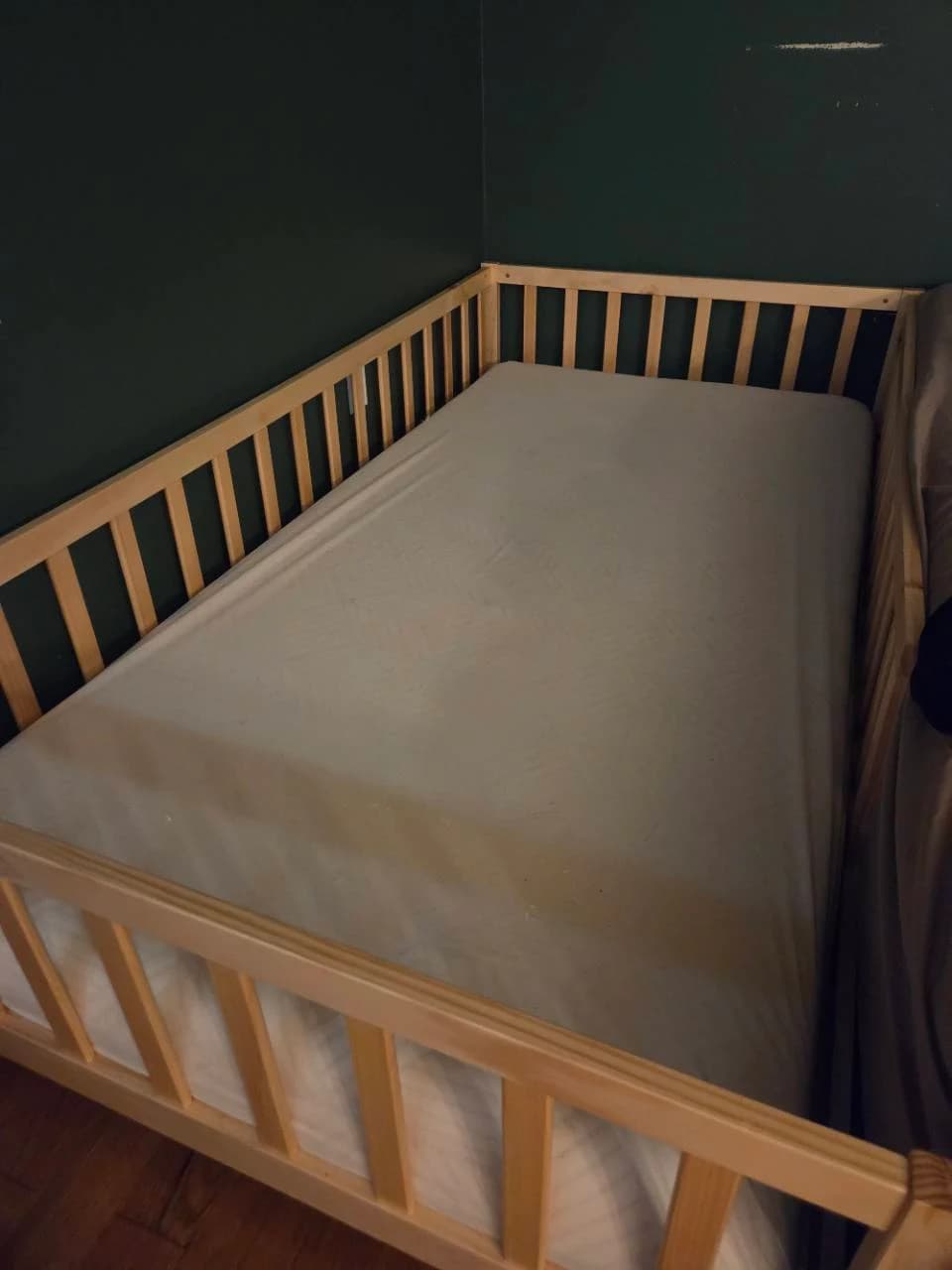
An ordinary mattress placed on the floor is not automatically a safe sleep space for a baby. For infants under one year, the American Academy of Pediatrics recommends a firm, flat sleep surface in a crib, bassinet, portable crib, or play yard that meets current CPSC safety standards.
The baby should be placed on their back, in their own sleep space, with only a fitted sheet. Keep pillows, blankets, bumpers, toys, positioners, and other soft objects out.
“Montessori,” “floor bed,” “firm,” and “breathable” are marketing or descriptive words—not proof that a product is approved for infant sleep.
For the common six-month-old question: No, a standard twin or toddler mattress on the floor is not the AAP-recommended substitute for a compliant crib or other approved infant sleep product.
What the AAP recommends for babies
The AAP's current safe-sleep guidance says babies should sleep:
- on their back for every sleep;
- on a firm, flat, non-inclined surface;
- in a crib, bassinet, portable crib, or play yard meeting CPSC standards;
- with a fitted sheet and no loose bedding or soft objects;
- in the parents' room, close to the parents' bed, ideally for at least the first six months; and
- away from smoke and weighted sleep products.
HealthyChildren also explains that an alternative sleep surface is appropriate only when it meets the applicable CPSC rule and relevant safety standards. A product listing that says “baby floor bed” without identifying the applicable infant product standard is not enough.
Why a floor mattress is different from a crib mattress
A compliant crib is a complete system: frame, slat spacing, mattress support, side height, hardware, mattress fit, labels, and instructions. A full-size crib mattress is sized to fit that regulated enclosure.
Putting an adult or kids' mattress on the floor changes the system. Potential concerns include:
- a gap between the mattress and wall or nearby furniture;
- softness or surface contour not designed for infant sleep;
- the baby reaching cords, outlets, furniture, pets, siblings, or other hazards;
- bedding or pillows added to stop rolling;
- moisture or mold beneath a poorly ventilated mattress;
- portable rails not intended for infants; and
- no product standard or instructions covering the complete setup.
The AAP's 2022 policy specifically says adult-sized beds and mattresses are not designed for infant sleep. It also says portable bed rails should not be used with infants.
“Firm” is necessary—but not sufficient
Parents sometimes hear that a surface is fine if the mattress feels firm. Firmness matters, but the AAP recommendation includes much more:
- the surface is firm and flat;
- the sleep product meets the applicable CPSC standard;
- the mattress is designed for that product;
- the fitted sheet fits correctly;
- the sleep space is bare; and
- the baby is placed on their back.
A firm twin mattress does not become a crib because it is low to the ground.
What about a Montessori floor bed with rails?
Rails do not solve the infant problem. A decorative wood enclosure or separately purchased rail can introduce openings between the mattress, frame, rail, and wall.
CPSC says portable bed rails are typically for children ages two to five who can get in and out of an adult bed without help. Required warnings say never to use one for a child under two or as a crib substitute. Read the CPSC portable-bed-rail guidance.
A product called a “crib” still needs to comply with the applicable crib rules and be used exactly as instructed. A floor-level crib base supplied by a manufacturer is different from placing a crib mattress inside a homemade or decorative floor frame.
Can a six-month-old sleep on a floor bed?
The evidence-based answer is to keep using an approved infant sleep space. At six months, a baby may roll, sit, crawl, pull on objects, and move around a room before they understand hazards.
Room childproofing is important, but it does not replace a compliant infant sleep product. Use a CPSC-compliant crib, bassinet within its limits, portable crib, or play yard, and follow its manual.
If the baby is approaching a bassinet limit, the usual next step is a compliant crib, portable crib, or play yard—not an ordinary floor mattress. If mobility, reflux, disability, or another medical need changes the situation, ask the child's pediatrician for individualized guidance rather than using a sleep positioner or improvised surface.
What if the baby is climbing out of the crib?
First confirm the crib mattress is at the lowest permitted setting and remove objects that can be used as steps. Check the crib manual's height and milestone limits.
If a baby appears able to climb out before reaching the age for a labeled toddler bed, contact:
- the pediatrician;
- the crib manufacturer; and
- an appropriate child-safety professional if the home setup is complex.
Do not lower the mattress below the designed support, remove a crib side without an approved conversion kit, add a tent, or surround an adult mattress with portable rails.
Floor bed, toddler bed, and crib are different categories
How common sleep-product terms differ
| Term | What it usually means | Infant use |
|---|---|---|
| Crib | A regulated infant sleep product with frame, mattress-support and dimensional requirements | Use within the exact age, height, milestone and assembly instructions |
| Bassinet / bedside sleeper | A regulated infant product for early months with specific limits | Use only until the stated weight or mobility limit |
| Portable crib / play yard | A regulated portable infant sleep product | Use the supplied or specified mattress and fitted sheet; do not add padding |
| Toddler bed | A bed using a full-size crib mattress for a child at least 15 months old and no more than 50 pounds | Not the standard category for a baby under 15 months |
| Montessori / floor bed | A style description covering many unregulated kids-bed and mattress arrangements | Not approved for infant sleep based on the name alone |
When does a toddler floor bed become relevant?
CPSC defines a toddler bed for a child at least 15 months old and no more than 50 pounds. That is a product-category boundary, not a promise that every 15-month-old is ready for every twin floor bed.
For a toddler transition:
- follow the current crib limits;
- choose a bed labeled for the child's age and weight;
- fit the exact permitted mattress;
- use only integrated or approved rails;
- anchor furniture and secure windows, cords, stairs, and exits; and
- ask the pediatrician when health or development affects the plan.
For older children, use the Montessori floor-bed setup guide and safety checklist, and begin the crib-to-floor-bed guide with readiness and whole-room childproofing.
Safer sleep alternatives to an infant floor bed
Full-size crib
A compliant full-size crib offers the most room and usually lasts longer than a bassinet. Lower the mattress support as instructed when the baby reaches new mobility milestones.
Portable crib or play yard
Use a current compliant model exactly as sold. Do not add an aftermarket mattress or extra padding unless the product instructions explicitly identify it as approved.
Bassinet or bedside sleeper within limits
These can be appropriate early sleep spaces, but babies outgrow them by weight or developmental milestone. Move to another compliant infant product when any limit is reached.
Room-sharing, not bed-sharing
AAP recommends the baby's separate sleep surface in the parents' room, ideally for at least six months. A separate compliant product provides closeness without placing the baby on an adult mattress.
How to evaluate a product marketed as a “baby floor bed”
Ask the seller for specific, written answers:
- What CPSC product category is this?
- Which mandatory standard applies?
- What age, weight, height, and mobility limits appear on the label?
- Which exact mattress and sheet are approved?
- Where is the current manual?
- How is the product registered and checked for recalls?
Vague claims such as “Montessori approved,” “non-toxic,” “breathable,” or “meets all standards” do not answer those questions. If the seller cannot identify the actual infant product category and standard, do not treat it as an approved infant sleep space.
The bottom line
For the first year, follow the AAP and CPSC pathway: a compliant crib, bassinet, portable crib, or play yard; firm flat mattress; fitted sheet; back to sleep; bare sleep space.
Save the floor-bed decision for the toddler transition, when the child meets the bed's stated minimum age and the whole room can safely support independent movement. A lovely Montessori room can wait. Infant sleep safety should not depend on an aesthetic label.
