
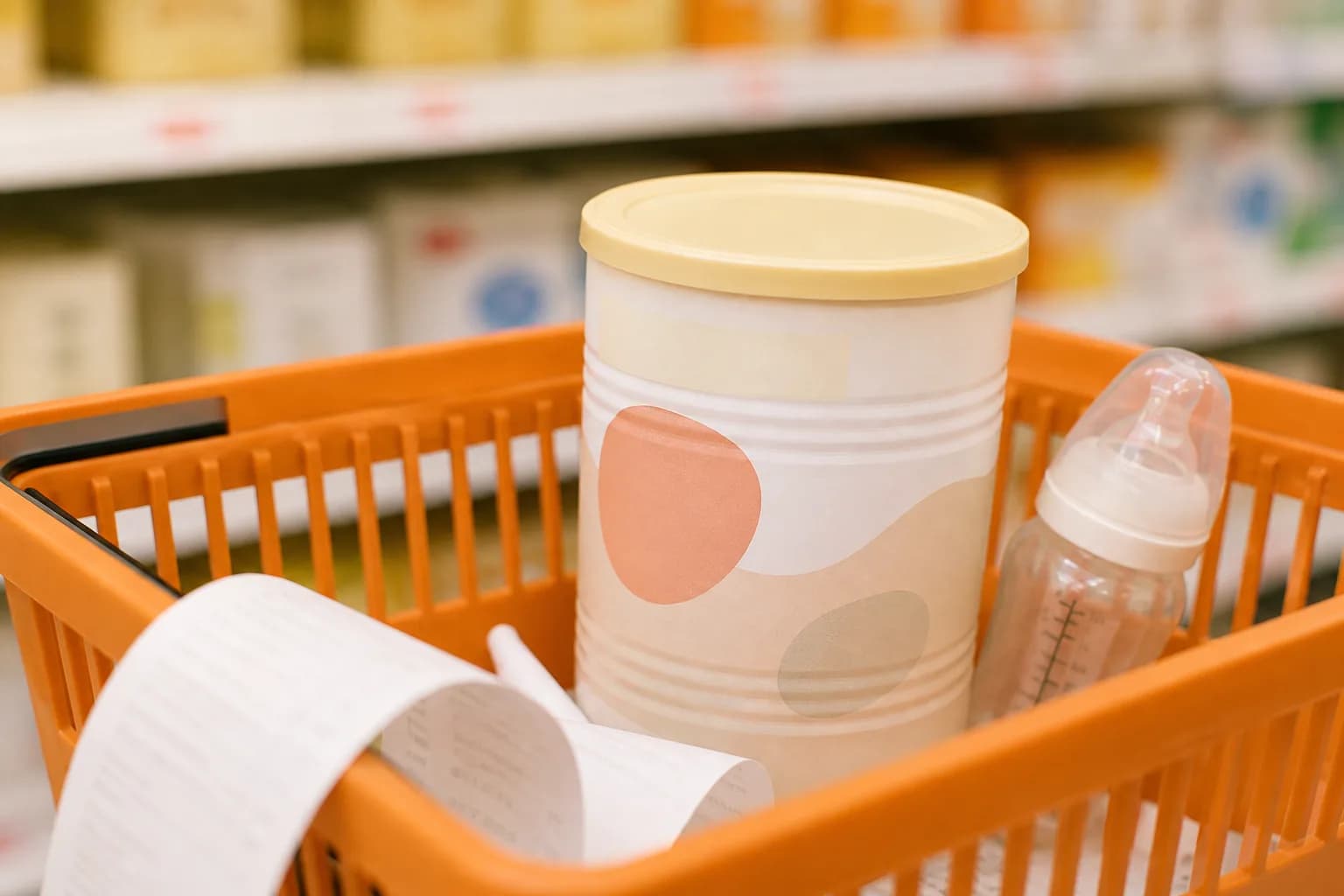
Kroger Comforts infant formulas are manufactured by Perrigo, the company behind major U.S. store-brand formula lines. The useful comparison is formula type—not can color or the retailer name.
Perrigo's current store-brand guide lists Kroger Comforts versions of Infant Premium, Gentle Premium, Advantage Premium, Sensitivity Premium, and Soy. Those categories serve different nutritional and tolerance purposes and should not be swapped as if they are flavors.
Medical note: Store-brand formula can be a complete, regulated infant formula, but the right category still depends on the baby. Specialty needs, allergy concerns, prematurity, poor growth, blood in stool, persistent vomiting, or other symptoms require clinician guidance.
Who makes Kroger Comforts formula?
Perrigo identifies itself as the maker of store-brand infant formula and lists Kroger in its October 2025 Store Brand Infant Formula Quick Guide.
The chart maps the same Perrigo formula families across retailers such as Walmart, Target, Sam's Club, Amazon, Kroger, Meijer, and CVS. That is why two store brands can have similar ingredient panels even though the front labels are different.
Manufacturer information and retailer contracts can change. Check the current can and Perrigo guide rather than treating this page as permanent packaging documentation.
Kroger Comforts formula types
Kroger Comforts families in Perrigo's current store-brand guide
Swipe across the table to see every column.
| Kroger name | Perrigo formula family | What to compare before switching |
|---|---|---|
| Comforts Infant Premium | Infant Premium | Routine milk-based formula type, protein, carbohydrates, prebiotics, scoop ratio |
| Comforts Gentle Premium | Gentle Premium | Protein hydrolysis, lactose level, carbohydrate source, intended use |
| Comforts Advantage Premium | Advantage Premium | Routine formula ingredients and prebiotic/HMO package |
| Comforts Sensitivity Premium | Sensitivity Premium | Lactose claim, intact protein, carbohydrate source, medical restrictions |
| Comforts Soy | Soy | Soy protein category, clinician reason for use, label restrictions |
The chart does not mean all five formulas are interchangeable. It means Kroger carries several Perrigo store-brand formula families.
What “equivalent” really means
A store-brand comparison usually means the formula is designed as an alternative in the same broad category and meets U.S. infant-formula requirements. It does not mean:
- the ingredient list is word-for-word identical;
- the scoop has the same volume;
- every prebiotic or HMO is the same;
- the powder smells, looks, or mixes exactly the same;
- one baby's stool will remain unchanged; or
- cans from two brands can share a scoop.
Compare the current Nutrition Facts, ingredient list, allergen statement, preparation panel, and age category. If the pediatrician specified a medical or specialty formula, ask before substituting a routine store-brand category.
The price question without cutting safety corners
Store brands are often chosen to reduce feeding costs. That can be meaningful, particularly when a baby uses formula for many months.
Compare prepared ounces, not only can price:
- Find the net powder weight.
- Read the label's estimated prepared volume or servings.
- Divide the price by prepared ounces.
- Include coupons or loyalty discounts only when they are actually repeatable.
- Do not buy more than can be used before the use-by and opened-can deadlines.
A lower cost per can is not savings if the formula is the wrong category or repeatedly unavailable.
Can you switch between store brands?
The FDA says most healthy babies can do well with different brands when they remain in the same formula type, including store brands. It still recommends involving the pediatrician because the clinician knows the baby's health history.
Before switching:
- match routine milk-based with routine milk-based, not with hypoallergenic or soy;
- compare intact versus partially hydrolyzed protein;
- compare lactose and other carbohydrate sources;
- check the exact age category;
- use the new can's own scoop and directions; and
- track meaningful symptoms rather than one diaper.
Never combine two dry powders and assume their scoops are equivalent. If a clinician recommends a gradual transition, prepare each product according to its own label before combining prepared amounts.
Comforts Gentle vs Sensitivity
These names sound similar but describe different approaches.
- Gentle formulas commonly use partially hydrolyzed protein.
- Sensitivity formulas commonly reduce lactose while retaining intact milk protein.
That distinction mirrors the central issue in Similac Total Comfort vs Sensitive: protein structure and carbohydrate design are separate variables.
Read the current Comforts labels because store-brand recipes and names can evolve.
Preparation and storage
Use only the scoop supplied with the Comforts can. Measure water first and follow the exact ratio. Do not copy a ratio from another Perrigo or national-brand can just because the category looks equivalent.
FDA handling rules still apply:
- use safe water;
- keep powder dry;
- use prepared formula within two hours;
- refrigerate a freshly prepared untouched bottle immediately if it will be stored, then use within 24 hours;
- discard leftovers within one hour after feeding begins; and
- never microwave formula.
The specific can can be stricter.
Recall and lot-number checks
Infant-formula safety notices are lot-specific. Save or photograph:
- the complete front label;
- UPC;
- lot code;
- use-by date; and
- manufacturer contact information.
Check the FDA infant-formula page, Perrigo notices, and the retailer's recall channel. Do not rely on an old social post that says “all store brand formula” or “no Comforts formula” is affected.
Bottom line
Perrigo makes Kroger Comforts formula, and the lineup includes several distinct store-brand families. Compare the formula category, not the orange Kroger shelf tag. A store-brand equivalent can be a practical routine option, but use the exact scoop and label and involve the pediatrician when symptoms or specialty needs drive the switch.
Sources checked August 2026: FDA infant formula guidance for parents and caregivers, CDC formula preparation guidance, and Perrigo’s current store-brand formula comparison guide. Match the exact can, formula category, scoop, and instructions rather than relying only on an “equivalent to” label.