
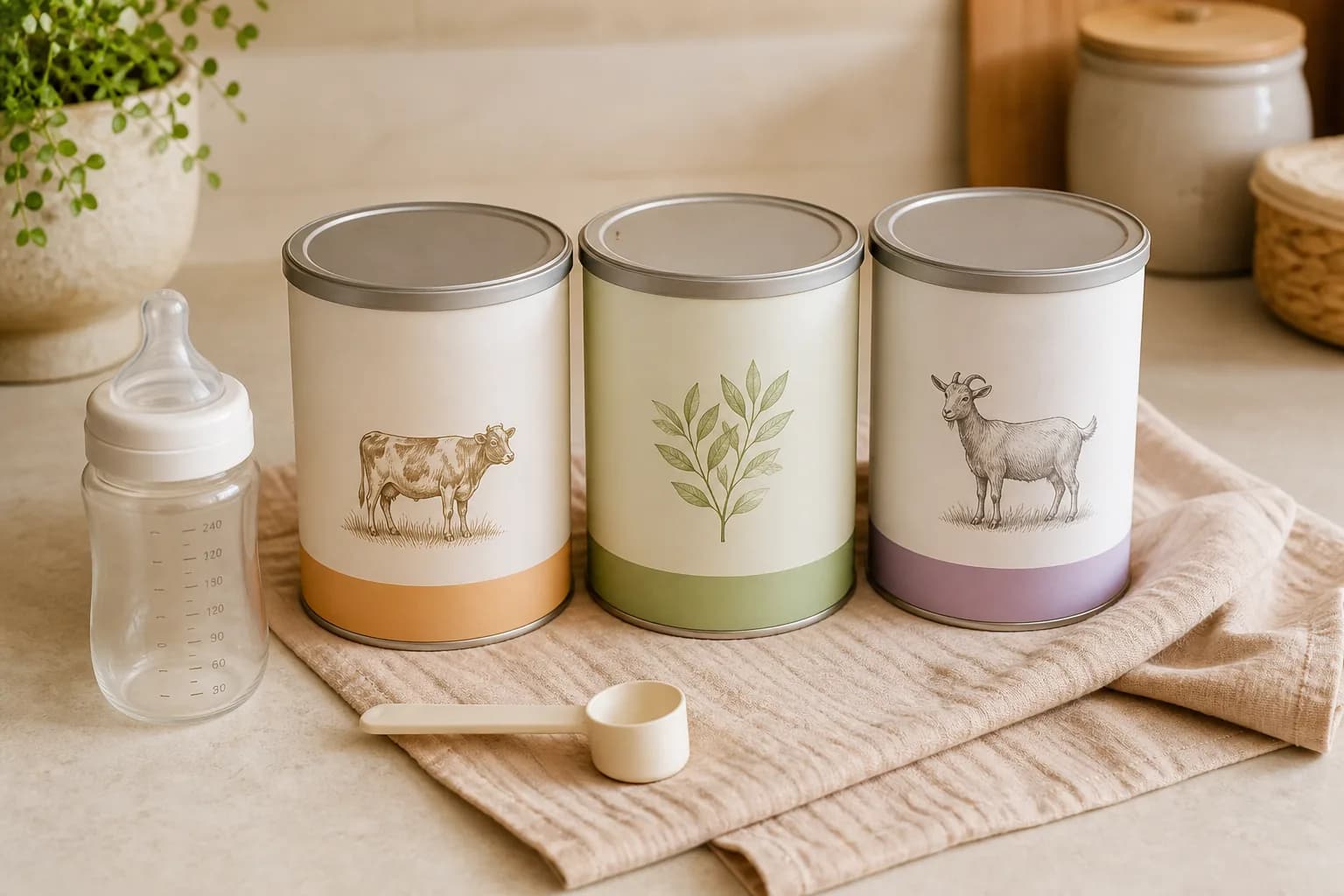
The practical difference in Kendamil Classic vs Organic vs Goat is the milk source and certification—not a simple good/better/best ladder.
- Classic is the routine cow's-milk option.
- Organic is also cow's-milk based, with USDA and EU organic certification.
- Goat uses goat milk and goat whey, but it is still a milk-protein formula and is not a hypoallergenic substitute for a diagnosed cow's-milk protein allergy.
All three current U.S. product pages use the same basic mixing ratio: one level scoop from that can for each 1 fluid ounce of water. Always use the scoop and directions from the exact can in your kitchen because recipes, labels and preparation instructions can change.
Medical note: Formula choice is individual, especially for premature infants, poor growth, persistent vomiting, blood or mucus in stool, suspected allergy, or other medical needs. Your pediatrician should guide specialty-formula decisions.
Kendamil Classic vs Organic vs Goat chart
Current U.S. Kendamil infant formula differences
Swipe across the table to see every column.
| Feature | Classic | Organic | Goat |
|---|---|---|---|
| Primary dairy source | Whole cow’s milk and cow’s-milk whey | Organic whole cow’s milk and organic cow’s-milk whey | Whole goat milk and goat-milk whey |
| Organic certification | No | USDA Organic and EU Organic | No |
| Contains milk protein | Yes | Yes | Yes |
| Hypoallergenic formula | No | No | No |
| Current U.S. mixing ratio | 1 level scoop per 1 fl oz water | 1 level scoop per 1 fl oz water | 1 level scoop per 1 fl oz water |
| Most useful decision question | Do we need a routine cow’s-milk formula? | Does certified organic sourcing matter to our family? | Did the pediatrician agree a routine goat-milk formula is reasonable? |
Information was checked against the current U.S. Classic, Organic, and Goat product pages on August 23, 2026. The can label controls.
Kendamil Classic: the routine cow's-milk choice
Kendamil Classic starts with whole cow's milk and whey. The current U.S. page describes a whole-milk recipe with lactose, milk-fat-globule-membrane components naturally present in the dairy ingredients, HMOs, and GOS/FOS prebiotics.
The useful reason to choose Classic is simple: you want a standard Kendamil cow's-milk infant formula and do not specifically need organic certification. It is not the “low-quality” option. Infant formulas marketed in the U.S. must meet federal nutrient requirements, and a higher shelf price does not prove that one healthy baby will tolerate a formula better.
Classic still contains intact milk ingredients. A “whole milk” label does not make it appropriate for a diagnosed milk-protein allergy.
Kendamil Organic: what the certification changes
Kendamil Organic uses organic whole cow's milk, organic whey, organic vegetable oils, and other ingredients listed on the current U.S. label. Kendamil says it is certified to both USDA Organic and EU Organic standards.
Organic certification concerns how agricultural ingredients are produced and handled. It does not mean:
- the formula is dairy-free;
- the milk proteins are hydrolyzed;
- the formula treats reflux, constipation, or allergy;
- every baby will digest it more easily; or
- parents using Classic are giving incomplete nutrition.
Choose Organic when the certification and sourcing fit your priorities and budget—not because a green label promises a medical outcome.
Kendamil Goat: a different milk source, not allergy treatment
Kendamil Goat uses whole goat milk and demineralized goat whey. Its current U.S. ingredient list still carries a contains milk allergen statement.
Goat-milk infant formula can be a routine formula option for some healthy, full-term babies. It is not the same thing as plain goat milk, goat toddler drink, or a homemade recipe. Only an actual infant formula designed for the baby's age supplies the required nutrient profile.
It is also not a safe workaround for a diagnosed cow's-milk protein allergy. The AAP notes high cross-reactivity between cow- and goat-milk proteins, and the NHS says goat formula is not suitable for infants with cow's-milk allergy. A clinician may recommend an extensively hydrolyzed or amino-acid formula instead, depending on the diagnosis.
The 2026 U.S. label and recipe transition
Kendamil announced updated permanent U.S. recipes and labels in 2026. The company says families may notice changes in ingredient order, mineral sources, nutrient declarations, appearance, smell, or mixing. It also changed the U.S. preparation direction from letting boiled water cool for 30 minutes to five minutes before mixing.
That means two cans on a shelf can look slightly different during the transition without one automatically being counterfeit or recalled. Compare:
- the exact product name;
- infant versus toddler labeling;
- the use-by date and lot code;
- the seal and container condition;
- the ingredient and preparation panel; and
- any current manufacturer notice.
Kendamil's 2026 U.S. update says old and updated versions can both be used as labeled. If combining prepared old and new formula during a transition, follow the directions on each can separately; do not mix two dry powders and guess at a shared scoop ratio.
Which Kendamil is “easiest to digest”?
There is no honest universal answer. A label can tell you the protein source, carbohydrate, fat blend, and whether proteins are intact or hydrolyzed. It cannot predict one baby's gas, spit-up, stool pattern, feeding skill, or medical needs.
Do not treat ordinary gas, grunting, or one unusual diaper as proof that a formula is failing. Newborns are noisy, feeding technique matters, and normal stool patterns vary. Look at the complete pattern: comfort, intake, wet diapers, growth, vomiting, stool consistency, and the pediatrician's assessment.
Our guide to Kendamil and constipation separates hard stool from normal straining.
A practical decision process
- Confirm that you need a routine infant formula. Medical or allergy concerns can change the category entirely.
- Choose the milk source with the pediatrician. Cow and goat formulas are both milk-protein products.
- Decide whether organic certification matters. That is the clearest distinction between Classic and Organic.
- Check local availability and cost. Repeated forced switching because one version is never stocked may be harder than choosing an accessible routine formula.
- Use the exact can correctly. Safe preparation matters more than internet debates about the prettiest ingredient list.
- Track meaningful tolerance signs. Feeding, hydration, growth, persistent vomiting, hard stool, blood, rash, or breathing symptoms matter more than a single green diaper.
Bottom line
For a healthy baby who can use routine milk-based formula, Classic is the straightforward cow's-milk option, Organic adds certified organic sourcing, and Goat changes the animal milk source. None is universally superior, and none of the three is a hypoallergenic formula.
Once you choose a can, use our Kendamil preparation guide and formula storage timeline rather than relying on a social-media shortcut.
Sources checked August 2026: FDA infant formula guidance for parents and caregivers, CDC formula preparation guidance, and the current U.S. manufacturer pages for Kendamil Classic, Organic, and Goat. Product labels and medical guidance control when allergy or specialty-feeding concerns are involved.