
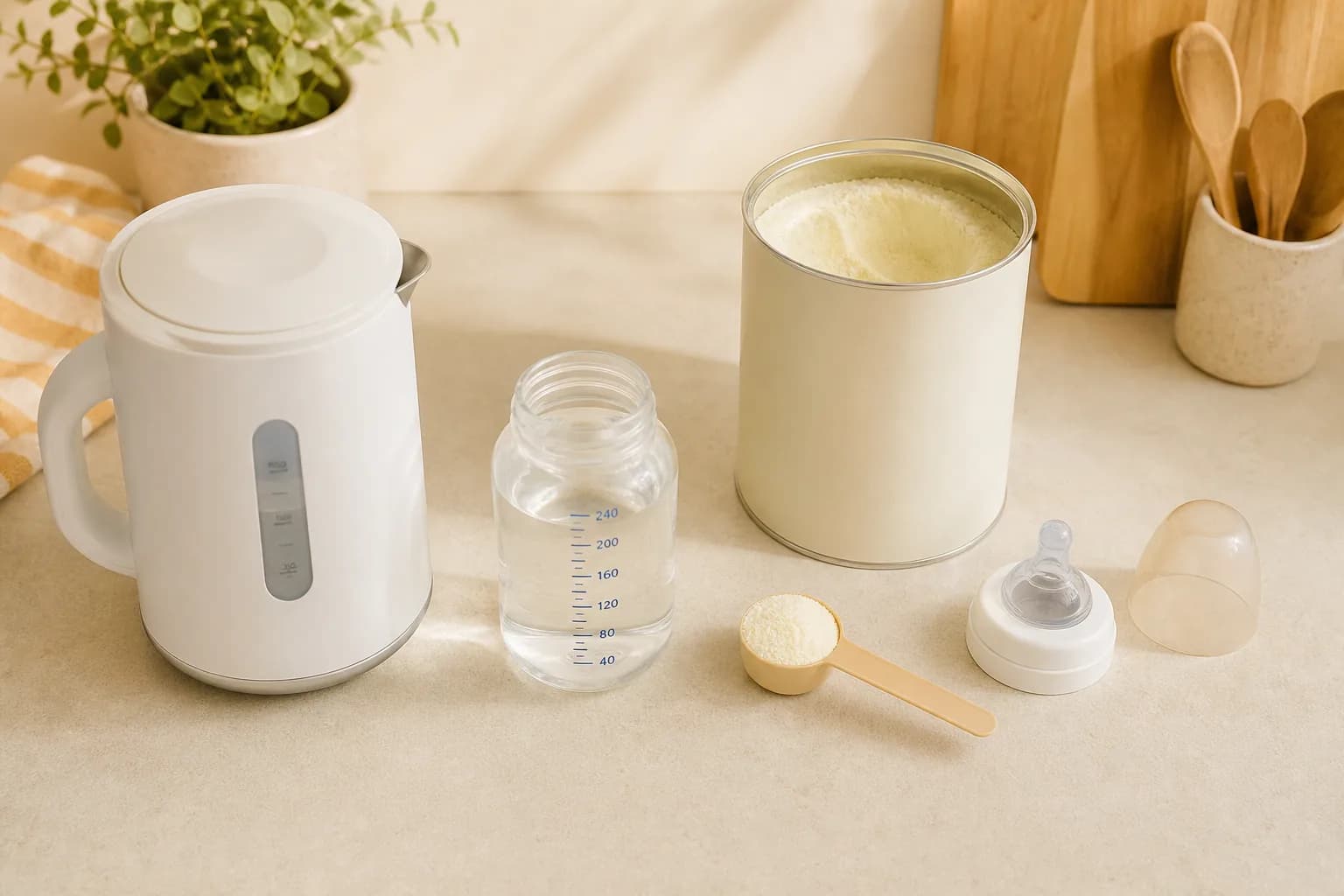
The current U.S. Kendamil Classic, Organic, and Goat instructions say to bring fresh water to a boil, let it cool for five minutes, measure the water into a clean bottle, and immediately add one level scoop from that can for every 1 fluid ounce of water.
That is different from older U.S. cans and many UK instructions that referenced a 30-minute cooling period. Use the directions printed on the exact can you purchased.
Safety note: Powdered infant formula is not sterile. Babies younger than two months, babies born prematurely, and babies with weakened immune systems may need extra precautions. Ask the pediatrician whether ready-to-feed formula or a specific preparation method is appropriate.
Kendamil preparation at a glance
Current U.S. Kendamil preparation sequence
Swipe across the table to see every column.
| Step | What to do | Why it matters |
|---|---|---|
| 1. Clean | Wash hands and prepare a clean work surface and feeding equipment | Reduces cross-contamination |
| 2. Check | Confirm the can is sealed or properly stored, in date, and undamaged | Avoids expired or compromised formula |
| 3. Boil | Bring 32 fl oz of fresh water to a boil; do not use repeatedly boiled water | Follows the current U.S. Kendamil label sequence |
| 4. Cool | Let the boiled water cool for 5 minutes | Matches the updated U.S. instructions |
| 5. Measure water | Pour the required water into the bottle first | Protects the dilution ratio |
| 6. Add powder | Use 1 level scoop from that can per 1 fl oz water | Prevents over- or under-concentration |
| 7. Mix | Cap and shake well to dissolve | Distributes the powder as directed |
| 8. Cool and test | Cool the capped bottle under cold running water and test on the wrist | Prevents burns |
| 9. Feed or discard | Once feeding begins, use within 1 hour and discard leftovers | Saliva allows bacteria to grow |
Source: current U.S. Kendamil Classic, Organic, and Goat pages, checked August 23, 2026.
Step 1: clean hands, surface, bottle, and parts
Wash your hands with soap and water for at least 20 seconds. Clean the preparation surface. Use feeding items that have been cleaned and, when your baby's situation requires it, sanitized according to current public-health and clinician guidance.
Do not place the scoop on a wet counter or put a damp scoop back into the powder. FDA guidance says powdered formula is less likely to become contaminated when it stays dry.
Step 2: inspect the can
Before opening or scooping, check:
- the exact product and age category;
- the use-by date;
- the seal and lid;
- dents, swelling, rust, moisture, insects, or damage; and
- any active manufacturer or FDA notice affecting the lot.
Do not use a can that is expired or compromised. Keep the lot code until the can is finished in case a safety notice appears.
Step 3: use water from a safe source
The FDA says to use water from a safe source and contact the local health department if tap or well-water safety is uncertain. Ordinary bottled water is not sterile unless specifically labeled that way.
Kendamil's current U.S. instructions say to bring 32 fluid ounces of fresh water to a boil and not to use repeatedly boiled water. That does not mean making a 32-ounce bottle. It describes preparing a fresh supply of water before measuring the smaller amount needed for the feed.
Water emergencies, high elevation, wells, and local contaminant concerns can change the best process. Follow local public-health instructions and the baby's clinician.
Step 4: let the boiled water cool for five minutes
Kendamil updated its U.S. directions in 2026. Current U.S. pages say to cool freshly boiled water for five minutes, not the older 30-minute interval, before measuring and adding powder.
Do not use a random temperature or a social-media shortcut in place of the can. Labels differ across countries, and U.S. and UK products are not necessarily identical.
Step 5: measure the water first
Pour the required amount of water into the bottle before adding powder. Adding powder first can make the final concentration difficult to measure correctly.
Never add extra water to stretch formula. The FDA warns that too little water can contribute to dehydration, while too much water can provide inadequate nutrition and harm growth.
Step 6: add level scoops from the matching can
The current U.S. Kendamil ratio is one level scoop per one fluid ounce of water. Use the scoop supplied with that exact can and the straight edge inside the lid to level it.
Do not:
- pack or heap the scoop;
- swap scoops between brands, product types, or old and new cans;
- measure with a kitchen teaspoon;
- halve a scoop by eye; or
- combine two dry formula powders and assume one ratio.
If you are transitioning between products, prepare each formula exactly as its own label directs before combining prepared portions—only if the pediatrician and product directions support that plan.
Step 7: cap and shake
Attach the nipple and cap as directed, then shake well to dissolve the powder. Kendamil can look frothy after shaking. Foam alone does not mean the bottle is spoiled.
Persistent dry pockets, large clumps, or repeated mixing trouble deserve a check of water temperature, scoop leveling, powder storage, and the exact preparation order. See why Kendamil gets foamy or clumpy.
Step 8: cool the bottle safely
Run the capped bottle under cold water until it reaches a safe feeding temperature. Keep cooling water away from the nipple opening. Test a few drops on the inside of your wrist; it should feel lukewarm, not hot.
Formula does not have to be served warm. Never microwave it. Microwaves can create hot spots that burn a baby's mouth even when the bottle feels acceptable from the outside.
Step 9: follow the clock
Kendamil's current U.S. pages say to use the bottle within one hour after feeding begins or discard it. FDA guidance also says prepared formula should be used within two hours of preparation; if it is not used immediately, refrigerate it promptly and use within 24 hours. Kendamil recommends making feeds fresh when possible.
The simplest rule is:
- prepare close to feeding time;
- never save a bottle the baby has already drunk from;
- do not leave prepared formula sitting out; and
- use the strictest current instruction that applies to your can and situation.
Our Kendamil storage timeline separates unopened powder, opened powder, freshly mixed bottles, refrigerated bottles, and started feeds.
Common preparation mistakes
Using the UK directions for a U.S. can
Instructions vary by market and changed in 2026. Follow the physical can you are using.
Adding powder before water
This can produce an over-concentrated feed. Water first protects the intended dilution.
Reusing a partly finished bottle
Once the nipple has been in the baby's mouth, saliva enters the formula. Discard the remainder after the allowed feeding window.
Keeping the scoop wet
Moisture can introduce contamination and cause powder to clump. Keep the scoop and can interior dry.
Treating a formula pitcher as automatically safe
Batch preparation needs exact measurement, immediate refrigeration, clean equipment, and agreement with the product instructions and baby's clinician. Fresh preparation is Kendamil's default recommendation.
Bottom line
For current U.S. Kendamil infant formula: clean first, use safe fresh water, boil and cool it for five minutes, measure water first, add one level matching scoop per fluid ounce, shake, cool, and follow the feeding clock. The exact can—not an old blog post—has the final word.
Sources checked August 2026: CDC formula preparation and storage guidance, FDA infant formula guidance for parents and caregivers, and the current U.S. Kendamil Classic instructions. Always follow the exact label on the can in your kitchen.