
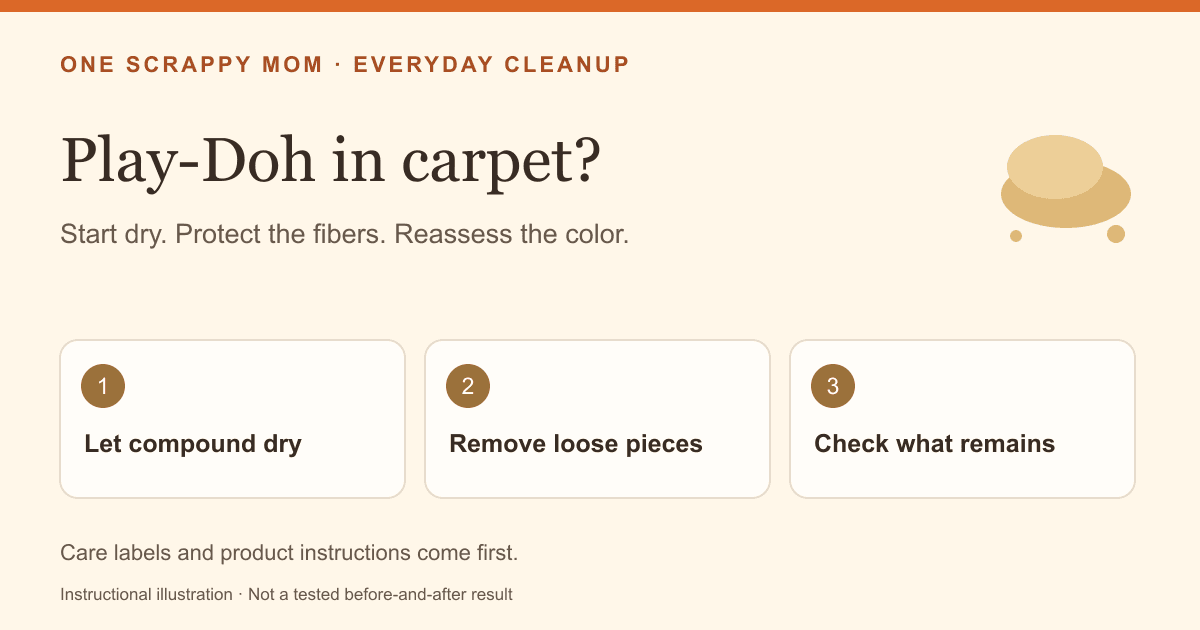
For branded Play-Doh in carpet, Hasbro recommends letting the compound dry completely before loosening and removing it. Don't start with hot water or a spray of cleaning chemicals. Check your carpet's own instructions too: a removal tool must not damage the fibers you are trying to save.
This is a manufacturer-sourced guide, not a cleanup experiment performed by One Scrappy Mom. The accompanying illustration shows the sequence, not an actual result. Homemade playdough, putty and slime may need different advice.
First: identify what is on the carpet
Find the tub or ask which recipe was used. “Playdough” often gets used for several different materials. This page centers on the familiar Hasbro compound; it is not a reason to apply the same steps to a sticky glue-based slime.
Keep feet, toys and the vacuum's wheels away from the patch while you work out the next step. Move the play activity onto a suitable washable surface. Take a quick picture so you can compare the patch later or show a carpet-care professional what happened.
Dough, stain or carpet damage?
| The patch looks like… | What that means for cleanup |
|---|---|
| Soft dough pushed into the pile | Follow the compound maker’s dry-first advice; do not spread it with wet scrubbing. |
| Dry crumbs sitting among the fibers | Remove loose material using methods allowed for your carpet. |
| Flat color after the crumbs are gone | Reassess it as a stain before choosing another treatment. |
| Pulled loops or a fuzzy, changed texture | Stop. More brushing will not repair physical damage. |
How to remove the dried Play-Doh
What Hasbro says—and the carpet-care caveat
Hasbro's removal instructions say to dry the compound, loosen it with a stiff brush, and vacuum; gentle soap and cold water may be needed afterward. The same answer warns against starting with hot water or cleaning solutions.
There is an important limit: the Carpet and Rug Institute's general care guidance warns that brushing and scrubbing can damage carpet. Don't treat Hasbro's brush suggestion as permission to scrub every rug. If your carpet instructions prohibit brushing, use only permitted removal methods and ask its manufacturer or a carpet professional about embedded pieces.
Remove what is loose, then look again
Once the compound is dry, collect loose pieces without tugging on the pile. Use the vacuum attachment or setting recommended for your carpet. Don't force a powered brush across a patch to grind away the remaining material.
Pause between passes. Look from the side as well as above: is there still a raised piece, or only a colored area? Repeating a removal step makes sense only while it is removing dough without changing the carpet.
Avoid cutting fibers to reach a crumb. If a piece is tangled into loops, the small mess is not worth turning into a permanent snag. Describe the carpet type and compound to a professional rather than escalating the tool.
The dough is gone, but a colored mark remains
The next decision is about the carpet, not about dissolving more dough. Check its warranty/care instructions for an approved stain treatment. The Carpet and Rug Institute advises testing a cleaner in a hidden spot, blotting rather than scrubbing, and removing cleaner residue afterward. Its general stain advice does not override Hasbro's dry-removal starting point.
If the carpet permits a wet treatment, keep it controlled and follow the exact product directions. Don't pour a basin of solution into the patch or improvise a sequence of different cleaners. For a valuable rug, unknown fiber, persistent stain or uncertain backing, ask a qualified cleaner before proceeding.
Should you use vinegar, steam or a hair dryer?
None is the starting method in Hasbro's cited instructions. A vinegar tip for slime is not automatically a Play-Doh tip. Adding heat or another liquid because the first pass was incomplete changes the method without establishing that the carpet can tolerate it.
For homemade dough, retain the recipe—especially the coloring and added ingredients—and ask for advice specific to the rug. Don't promise yourself that a homemade recipe will be easier to remove just because its ingredients came from the kitchen.
Before calling the job finished
- Check for remaining pieces without picking at the fibers.
- Compare the patch with the surrounding carpet for texture changes.
- If an approved wet treatment was used, follow its residue-removal and drying directions.
- Keep the product or recipe details if a stain needs professional attention.
- Put the next dough session on a washable tray or mat suitable for the play space.
Frequently Asked Questions
Should Play-Doh dry before removal from carpet?
Is a stiff brush safe on every carpet?
What if there is still color after the dough is gone?
Does this also work on slime?
Other craft-time messes
- Slime on clothes: residue versus leftover color
- Crayon on clothes: marks and melted wax
- Foam pumpkin decorating ideas
Sources checked September 7, 2026: Hasbro Consumer Care and the Carpet and Rug Institute, linked above. No cleaning outcome is guaranteed.