
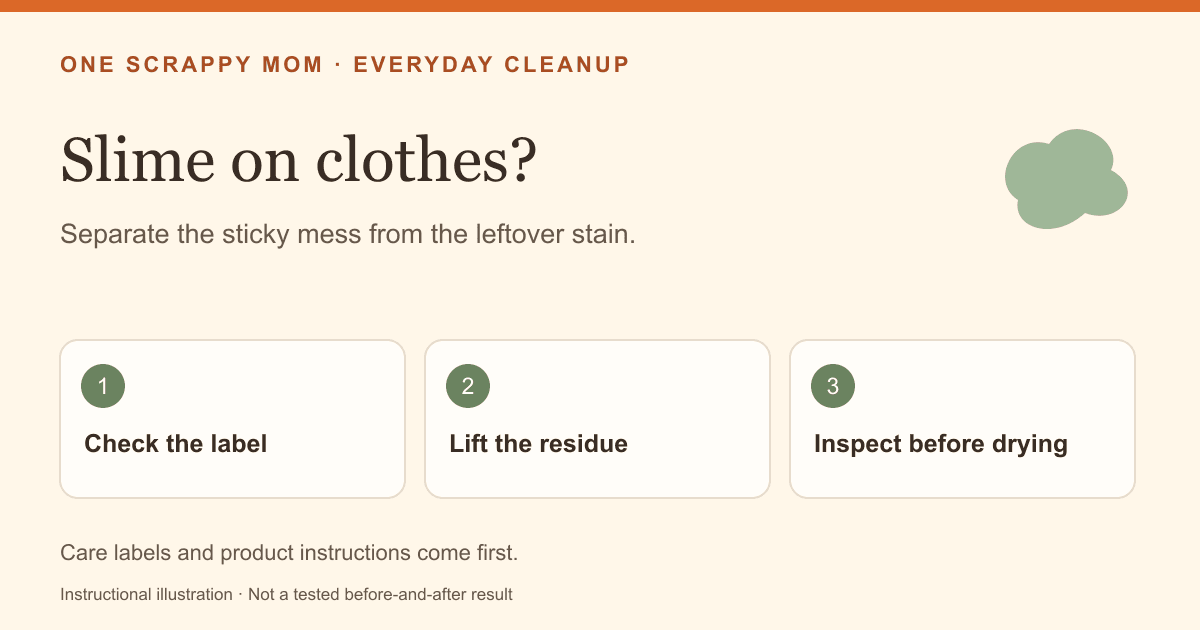
To get slime out of clothes, lift away loose slime, check the garment label and the slime maker's instructions, then treat the remaining residue before laundering. For some glue-based slimes, the maker recommends white vinegar. That is not permission to soak every fabric or mix household cleaners.
The important question is what remains: a sticky blob, a hardened patch, or just color. Those are different stages of cleanup. Deal with the material first rather than repeatedly washing a shirt with a lump still attached.
This is a researched guide, not a One Scrappy Mom cleaning test. The illustration is a decision aid, not a before-and-after photograph. Results depend on the slime ingredients, fabric and previous treatment.
Start with the shirt, not the cleaning hack
Read the care label before applying anything. Keep the slime container or recipe nearby so you can identify what spilled. A school-glue recipe and an unidentified stretchy toy should not automatically get the same treatment.
Which slime problem are you dealing with?
| What you see | Next decision |
|---|---|
| A loose, sticky blob | Lift what comes away without pulling the fabric; then check the maker’s residue-removal instructions. |
| A hard patch caught in fibers | Do not tear it free. Identify the fabric and seek a compatible softening or removal method. |
| No stickiness, but a colored mark | Move to a fabric-approved stain treatment rather than continuing to attack imaginary glue. |
| A dry-clean-only label or fragile trim | Ask a professional cleaner before wet treatment; bring the product details. |
Set the garment apart from the rest of the laundry. Work where you can see both sides of the stain, using a clean white cloth underneath. Keep bottles and loose slime pieces away from children and pets.
Fresh slime: a cautious removal sequence
1. Remove only what lifts easily
Use a spoon edge or your fingers to lift the loose mass gently. Don't pull against threads, snag knitwear or spread the slime across a clean area. Stop mechanical removal when the remaining material is embedded.
2. Match the treatment to the product
Rogue Slimes recommends white vinegar for its slime on fabric: apply it to the affected area, allow roughly 5–10 minutes, gently work the residue away, and rinse. This is a specific maker's advice, not a tested universal formula for every slime brand.
If your fabric's care instructions allow that treatment, test a hidden area first and check for color transfer or a change in texture. Use a cloth to control where the liquid goes. If the label rules it out, or the slime maker gives a different method, do not improvise with stronger vinegar or a longer soak.
3. Rinse, then launder within the label limits
Remove the treatment residue before moving to normal laundry care. Use the garment's permitted wash temperature and the detergent's instructions. A stain-removal blog does not override a delicate fabric's temperature limit.
Inspect before machine drying. If there is still residue or a mark, pause and reassess instead of running another heat cycle just to finish the load.
What if the slime has dried?
Don't peel a rigid patch off a stretchy shirt as though it were a sticker. Photograph the affected area, identify the slime if possible, and check the maker's removal advice for compatibility with the garment. Where an approved treatment loosens it, remove small amounts gradually. Stop if the cloth itself starts to distort.
Glitter, foam pieces and charms add another task: collect loose pieces separately instead of intentionally rinsing them down a drain. If color remains after the texture is gone, select a laundry stain remover labeled for that fabric and color, and use its directions. There is no guaranteed rescue for dye transfer.
Can you remove slime without vinegar?
Ask the slime maker for an alternative that fits the garment. No vinegar on hand does not make acetone, rubbing alcohol, drain cleaner or a homemade mixture the next logical step. If the label permits washing but you don't know the slime ingredients, contact the maker or a cleaner before escalating.
Stop if the fabric changes—or you don't know what was already applied
Do not layer cleaners over a previous treatment. In particular, never mix vinegar with chlorine bleach. Poison Control explains the hazards of vinegar misuse, including mixing it with bleach. Keep cleaning separate from children's play, and use products only as labeled.
A favorite dress, lined jacket or garment with glued decorations can be worth taking to a cleaner before experimenting. Tell them what the slime was and what you already tried. A useful cleanup record is simple: product, fabric, treatment and result—not a promise that every mark will disappear.
Frequently Asked Questions
Does vinegar remove every kind of slime?
Should I put slimy clothes straight into the washer?
What if the slime is gone but the shirt is still stained?
Can I use this method on carpet?
More help after craft time
- Play-Doh in carpet: why the approach is different
- Crayon on clothes, including a dryer accident
- Sleepover ideas for the next get-together
Sources checked September 7, 2026: Rogue Slimes care guidance and Poison Control, linked above. No affiliate shopping links or claimed hands-on results.