
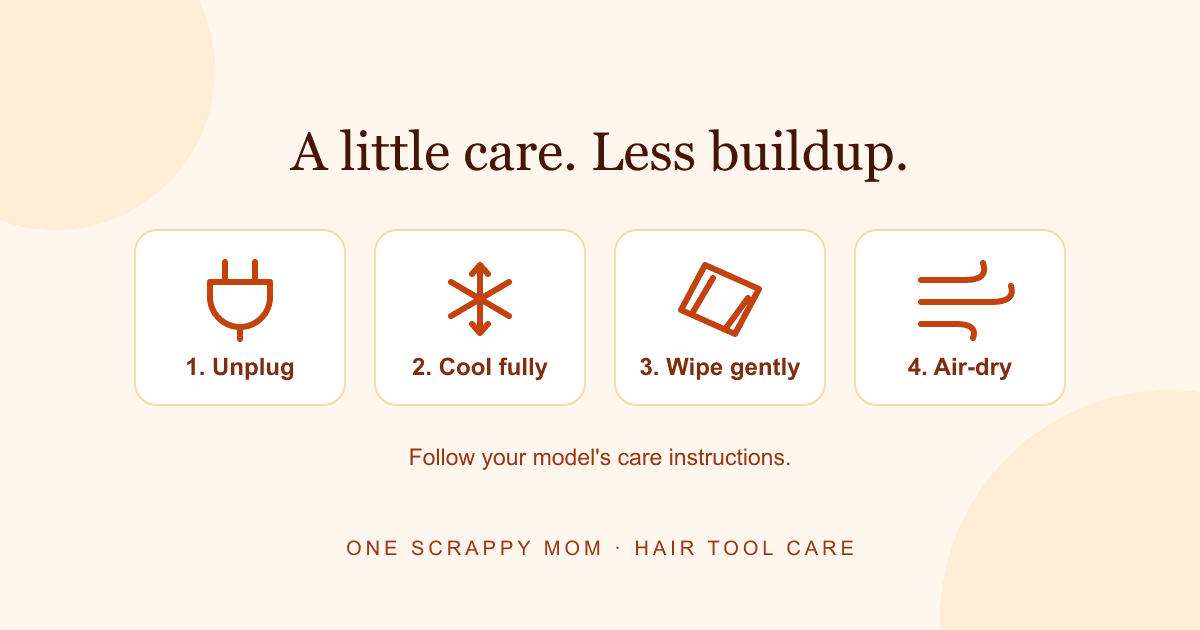
To clean a flat iron, unplug it, let it cool completely, and gently wipe the plates with a soft cloth lightly dampened with water—if your model's instructions allow it. Let it dry completely before plugging it back in. Don't dunk it, scrape it, or reach straight for a stronger cleaner.
Sticky plates are annoying. Scratched plates are a bigger problem. The goal is to remove the residue without turning a small maintenance job into a replacement purchase.
This is a manufacturer-sourced care guide, not a hands-on comparison of straighteners. It covers conventional heated-plate tools; steam straighteners, cordless models, and wet-to-dry tools may have different instructions. Start with the model number on your own device.
How to clean a flat iron, step by step
1. Check the instructions before choosing a cleaner
Look up the exact model, not just the brand. A cleaning suggestion for one tool isn't automatically permission to use it on another plate coating or electronic housing. Keep the manual open while you work, especially if it names a specific cleaning product or prohibits liquids on particular parts.
ghd's styling-tool care guide describes unplugging, cooling, wiping with a soft damp cloth, and allowing the tool to dry fully. That's a useful starting point—not a reason to ignore another manufacturer's manual.
2. Switch off, unplug, and let it become completely cold
Set the iron on a suitable heat-resistant surface while it cools. Keep the cord and tool away from the sink and out of children's reach. Don't warm the plates to soften residue or clean while the tool is connected to power. A busy bathroom counter is not the place to improvise around hot electrical equipment.
3. Wipe gently with a soft cloth
Use a clean, lint-free cloth, with one section lightly dampened and another section dry. Wring out the damp section so it isn't dripping. Wipe the plate faces and accessible exterior gently, without forcing cloth or moisture into the hinges, controls, or seams. Don't spray anything directly onto the tool.
Work in good light. After each pass, check the cloth so you aren't simply spreading residue back across the plate. If gentle wiping makes no progress, pause rather than adding pressure.
4. Dry fully before using or putting away
Wipe away visible moisture and leave the tool to air-dry safely. Don't turn it on to speed up drying. Follow your manufacturer's drying instructions; ghd specifically advises allowing a couple of hours and never using a still-damp tool. Avoid enclosing it in a storage pouch while moisture remains.
Sticky plates, brown marks, or snagging: what are you actually seeing?
You don't need a perfect diagnosis to choose the cautious next step. With the device unplugged and cold, distinguish residue that wipes away from a surface that appears physically damaged.
Flat iron residue or damage: what to check
Swipe across the table to see every column.
| What you notice | What to check | Next step |
|---|---|---|
| A sticky film on the plate | Does gentle wiping transfer residue to the cloth? | Continue lightly within the care instructions; stop if it does not lift. |
| A dark mark that stays put | Is the plate smooth, chipped, or peeling? | Do not scrape to find out. Ask the manufacturer about the mark. |
| Hair catching at an edge | Visible chips, a damaged seam, or plate misalignment | Stop using the tool and contact support. Cleaning will not repair hardware. |
| An unusual smell or erratic heating | Damage, contamination, or an electrical problem | Stop using it. Do not repeatedly switch it on as a test. |
Cleaning the straightener and deciding whether your hair should be heat-styled are separate questions. If you're also sorting out a color mishap, the hair dye remover guide covers that different problem. A clean tool does not reverse chemical damage.
Can you clean a flat iron with rubbing alcohol or baking soda?
Don't treat either as a universal flat-iron cleaner. Check the exact model's instructions before using alcohol, detergent, or any cleaning product beyond the recommended routine. If the instructions don't answer the question, ask support rather than guessing from a social-media video.
CLOUD NINE's care guidance warns against abrasive cleaners, sharp tools, and oil-based products. That makes scraping with a blade or scrubbing with a gritty paste a poor default. Stronger is not necessarily more effective when the surface you're trying to preserve is part of the appliance.
Skip these shortcuts unless the manufacturer explicitly instructs otherwise:
- Scrubbing pads, blades, or nail tools: don't turn a residue problem into a scratched surface.
- A bowl of cleaning solution: an electrical styler is not a hairbrush that can soak.
- Spraying into the hinge: you cannot see where the liquid ends up.
- Mixing household cleaners: no homemade cleaning cocktail is needed here.
- Oil to make the plates slippery: CLOUD NINE specifically discourages oil-based cleaning products, which can add buildup.
Does the method change for ceramic or titanium plates?
The material name alone isn't enough to choose a solvent. “Ceramic” can describe a coating, and the plate is only one part of the assembled tool. Plastics, seals, controls, and adhesives also matter. A cleaner that seems suitable for a bare metal object isn't automatically suitable for a finished appliance.
Use the model manual for both ceramic and titanium straighteners. Don't remove the plates or disassemble the housing to clean underneath them.
How often should you clean a hair straightener?
Use the manufacturer's maintenance schedule and keep an eye on visible residue. ghd suggests cleaning its heated tools every three months; your own model or pattern of use may call for different care. If the tool is catching hair or behaving unusually, don't just wait for the calendar reminder.
Keeping a clean cloth near the storage area makes routine care easier. Keep styling sprays away from the appliance itself and follow both your hair product's directions and the tool's instructions. More product on the plate isn't the same as better protection for your hair.
Before the next use: a quick check
- The tool is completely dry.
- The plates and housing show no cracks, peeling, or damage.
- The cord is intact and not pinched.
- The device is behaving normally; no unusual smell or erratic heat.
- The care method matched the exact model's instructions.
If any of those checks fail, stop and contact the manufacturer. The useful result is a tool that's safe to use—not a plate that merely looks shinier.
Frequently Asked Questions
Can I clean my flat iron while it is warm?
How do I clean burnt product off a straightener?
Can I use rubbing alcohol on flat-iron plates?
Can I use a baby wipe to clean a hair straightener?
Will cleaning fix a flat iron that snags hair?
More hair guides
- Color Oops: review and how-to guide
- Color Oops before and after: what changes
- Hair dye remover: different types and uses
Sources checked September 6, 2026: ghd tool care and CLOUD NINE straightener care. Your model's current instructions take priority.