
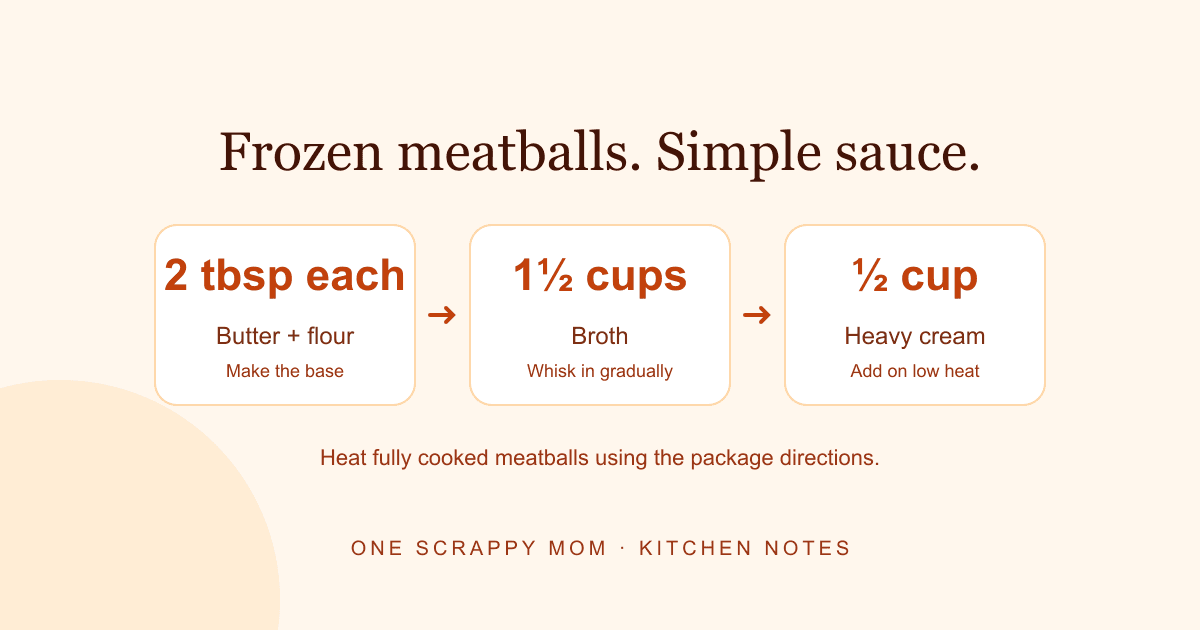
To make Swedish meatballs with frozen meatballs, heat fully cooked meatballs according to their package, make a cream gravy separately, and combine them just before serving. Keeping the two jobs separate lets you follow the right heating instructions without boiling the cream sauce while you wait.
This is a Swedish-style shortcut dinner, not a traditional from-scratch meatball recipe. The frozen bag does the rolling; the sauce does the heavy lifting.
Recipe note: This is an editorial recipe, not yet kitchen-tested by One Scrappy Mom. The sauce quantities below are a starting formula; heating time and seasoning depend on the meatballs and broth you use. No original cooking photos, taste-test results, or nutrition analysis are claimed.
Which frozen meatballs should you use?
Choose a bag labeled fully cooked, preferably homestyle or Swedish-style. An Italian-seasoned meatball can work as a different flavor combination, but its garlic, herbs, and cheese won't disappear under the gravy. Turkey and plant-based versions also bring their own flavor and heating instructions.
Read the label before shopping for the rest of the meal. Meatballs may contain wheat, milk, egg, or soy even when those ingredients aren't obvious from the name. Worcestershire sauce commonly contains fish; check its label too. This version contains dairy and wheat and is not an allergy-free recipe.
For an example of why the bag matters, Cooked Perfect's Homestyle Meatballs page identifies that product as fully cooked and provides separate heating directions. Those directions aren't interchangeable with instructions for raw frozen meatballs or a different size and brand.
Ingredients for Swedish meatballs with frozen meatballs
Start with 1 pound of fully cooked frozen meatballs. The sauce formula below makes roughly 2 cups before reduction—enough for a coated meatball dish with extra gravy, depending on what you serve alongside it. Treat the serving count on your meatball bag as the starting point; appetite and side dishes vary.
Ingredients for one pound of fully cooked meatballs
Swipe across the table to see every column.
| Ingredient | Amount | Notes |
|---|---|---|
| Fully cooked frozen meatballs | 1 pound | Follow the package heating instructions. |
| Unsalted butter | 2 tablespoons | Makes the base of the gravy. |
| All-purpose flour | 2 tablespoons | Thickens the broth; this is not a gluten-free sauce. |
| Lower-sodium beef broth | 1 1/2 cups | Chicken or vegetable broth changes the flavor but can be used. |
| Heavy cream | 1/2 cup | Add after the broth has thickened. |
| Dijon mustard | 1 teaspoon | Start here, then taste. |
| Worcestershire sauce | 1 teaspoon | Optional; check allergens and sodium. |
| Ground allspice | A small pinch, optional | Add cautiously; the meatballs may already be seasoned. |
| Black pepper | To taste | Add at the end. |
| Salt | Only if needed | Taste after combining with the meatballs. |
You'll also need a saucepan or deep skillet, a whisk, a measuring cup, and a food thermometer. Get the equipment for your bag's heating method ready as well. For measurement help, a pint equals 2 cups, and a quart equals 4 cups.
How to make the meatballs and cream gravy
1. Heat the meatballs as directed
Use the oven, microwave, or stovetop method specified on the package. Follow the directions for your portion size, including any stirring, standing time, or temperature checks. The outside looking hot is not a substitute for following the instructions.
This guide deliberately does not promise one cooking time for every frozen meatball. A tiny bite-size meatball and a large dinner-size one will not necessarily heat at the same rate. If the product is raw rather than fully cooked, use its complete cooking instructions instead of this reheating workflow.
2. Make the butter-and-flour base
While the meatballs heat, melt the butter in the saucepan over medium-low heat. Whisk in the flour until it forms a smooth paste. Cook, stirring, for about 1 to 2 minutes, adjusting the heat so the mixture doesn't scorch. This short cooking stage is for the sauce base, not the meatballs.
3. Add the broth gradually
Whisk in a small splash of broth first, loosening the paste. Add the remaining broth in stages, whisking smooth between additions. Bring to a gentle simmer and stir until it begins to coat the back of a spoon. Keep the pan attended; the bottom can thicken faster than the surface suggests.
4. Lower the heat and add the cream
Reduce the heat before stirring in the cream, Dijon, Worcestershire, and optional allspice. Warm gently rather than bringing it to a hard boil. Taste the sauce, but wait to make a final salt decision until it meets the meatballs. A salty bag and a salty broth can add up fast.
5. Combine and serve
Add the heated meatballs to the warm sauce and turn them gently to coat. If the sauce is too thick, stir in a little extra broth. Serve promptly over cooked egg noodles, mashed potatoes, or rice. A simple green vegetable gives the plate something that isn't beige. Dinner can be practical and still use a second color.
Can you use milk or sour cream instead?
Milk is thinner than heavy cream, so a direct swap changes the sauce's body. Expect to adjust the amount of liquid or the thickening method rather than assuming an identical result. Don't add dry flour straight into a finished sauce; it tends to form clumps.
Sour cream adds tang and also changes the finish. If you experiment with it, take the pan off the heat and stir a little warm sauce into the sour cream before adding it back gradually. Avoid boiling afterward. These variations have not been tested here; use the main formula if you want the simplest starting point.
What about cooking everything in a slow cooker?
This is a stovetop-sauce guide, not a validated slow-cooker recipe. Don't translate the package's oven or microwave time into an arbitrary number of hours on low. Use a manufacturer-supported slow-cooker method or a separately tested recipe for that appliance. Keeping dairy warm for a long cooking cycle also changes the sauce.
If the sauce isn't behaving
Cream gravy troubleshooting
| Problem | Adjustment to try |
|---|---|
| Too thick | Whisk in warm broth, a tablespoon at a time, before adding more. |
| Too thin | Let the broth-and-flour base thicken before adding cream; avoid flooding the pan with extra liquid. |
| Lumpy | Whisk the sauce before combining with meatballs; strain stubborn lumps if necessary. |
| Too salty | Do not add more seasoning. Serve less sauce with an unsalted side, or make additional unsalted sauce to dilute it. |
| Too strongly spiced | Omit optional allspice next time and choose a plainer meatball. Sauce cannot remove seasoning already inside the meat. |
| Greasy or separated | Lower the heat and stop hard boiling. Gentle whisking may help, but a split sauce may not fully recover. |
How to store and reheat leftovers
Follow USDA leftovers guidance: refrigerate within 2 hours, or within 1 hour when the temperature is above 90°F. Divide leftovers into shallow containers so they cool promptly; keep the refrigerator at 40°F or below.
Use refrigerated leftovers within 3 to 4 days and reheat to 165°F, checking with a food thermometer. Stir during reheating for more even heat distribution. A little broth can loosen thick gravy. Freeze portions you won't use in time; cream sauces may change texture after thawing. Don't use smell alone to decide whether leftovers are safe.
Frequently Asked Questions
Do I thaw frozen meatballs before making Swedish meatballs?
Can I use Italian frozen meatballs?
Does this sauce need cream of mushroom soup?
How much sauce do I need for one pound of meatballs?
Can I double the recipe?
Has One Scrappy Mom tested this recipe?
Keep dinner simple
Start with the right bag, heat it properly, and adjust the sauce before serving. If you're planning the rest of the meal, the Orange Julius recipe is another kitchen option. For scaling ingredients, keep the quart conversion chart handy.
Sources checked September 6, 2026: Cooked Perfect Homestyle heating guidance and USDA leftovers and food safety. Package directions control product-specific heating.