
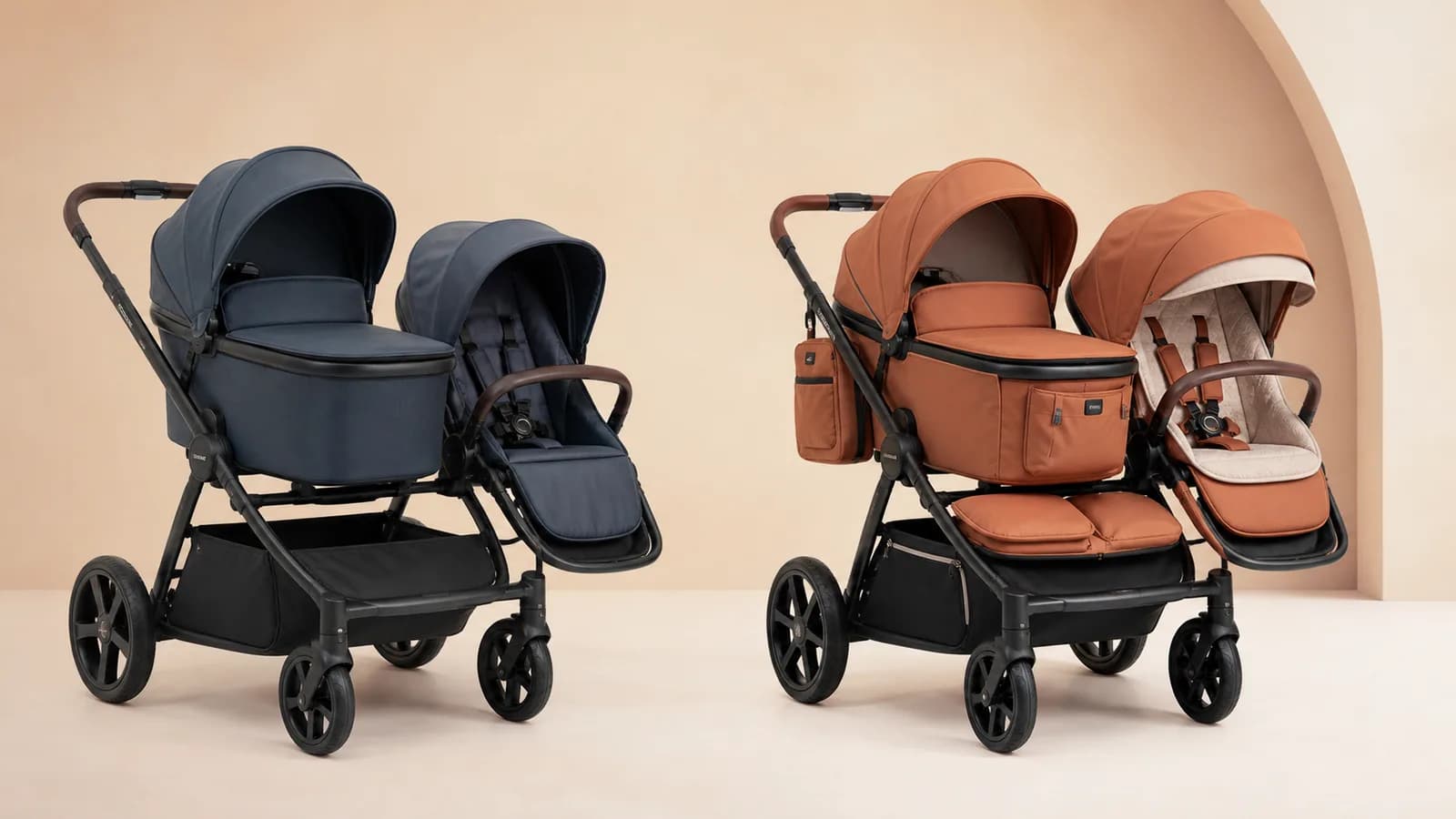
The difference between the Mockingbird 3.0 and 2.0 is mostly visible in the seat: the 3.0 has a built-in leg sunshade, reversible seasonal liner, magnetic harness, taller canopy position and more storage pockets. Those details help owners identify loose seats and parts that no longer have their box.
The frame generation matters most when ordering replacement parts. Many accessories cross generations, while canopies and some individual components do not.
Fast identification: A 3.0 seat has the built-in LegShade, magnetic buckle and reversible seasonal liner. A 2.0 seat lacks that combination. Always confirm the white frame label before ordering a structural or replacement part.
Specifications and compatibility were verified against Mockingbird's current support materials on August 23, 2026. Inventory and replacement-part support can change. See Mockingbird's official 3.0 change summary and cross-generation accessory compatibility guide.
Mockingbird 3.0 vs. 2.0 comparison
The practical differences between Mockingbird 3.0 and 2.0
| Feature | Mockingbird 3.0 | Mockingbird 2.0 | Does it matter? |
|---|---|---|---|
| Sun coverage | UPF 50+ canopy plus built-in LegShade | UPF 50+ canopy with visor and mesh panel; no built-in LegShade | Useful for exposed walks without draping fabric over the stroller |
| Seat liner | Reversible seasonal liner included | Original seat without the 3.0 seasonal liner | Helpful in hot/cool weather and for easier crumb cleanup |
| Harness | Magnetic buckle, softer straps and reflective piping | Original non-magnetic harness design | Faster daily buckling; not a reason to skip proper harness adjustment |
| Storage | Seat-back stash pocket, child pockets and larger phone pocket | Original seat storage | Convenient for small items, but basket remains the main cargo area |
| Canopy height | Up to about 21.5 in seat-to-canopy headroom | About 20 in on the prior seat | Meaningful for tall riders near the stroller limit |
| Style | Charcoal-frame option, solid canopy interiors and new colors | Silver frame, patterned canopy interiors and earlier colors | Purely preference unless matching an existing second seat |
1. FullShade adds actual lower-body coverage
The 3.0 combines its extendable canopy with a built-in UPF 50+ LegShade. That closes the open area around a child's legs and feet while maintaining the product's designed ventilation.
The 2.0 has a UPF 50+ canopy, pop-out visor and mesh airflow panel, but not the built-in lower shade. Families can still manage sun with route timing, clothing and age-appropriate sun protection. Do not drape a blanket over either stroller; that can reduce airflow and make it harder to monitor heat.
2. The seasonal liner is included on 3.0
The 3.0's reversible liner provides a warmer side for cool days and removes for a more ventilated seat surface. It can also catch crumbs and spills before they reach the main seat fabric.
When installing the separate Infant Seat Insert, Mockingbird instructs 3.0 owners to remove the seasonal liner first. The two products are not intended to stack together.
3. Harness and buckle are easier to manage
The 3.0 uses a magnetic buckle, softer harness materials and reflective piping. The no-rethread design helps adjust the harness as the child grows.
That convenience matters when loading two children repeatedly. It does not change the basic rule: every rider needs the harness properly buckled and adjusted according to the stroller manual.
4. More small-item storage
Mockingbird added a seat-back stash pocket, child pockets and a larger phone pocket. These additions may make the separately sold Parent Organizer unnecessary for families who only carry keys, a phone and a small snack.
The lower basket remains rated to 25 pounds. Access changes based on double-seat position, so a paper capacity number does not replace trying the intended setup.
5. Growing toddlers get more canopy room
Mockingbird's current height guidance describes approximately 20 inches from the seat to canopy on older seats and up to 21.5 inches with the 3.0 canopy adjustment. Both remain subject to the stroller's 42-inch child height limit and seat weight limit.
For a tall toddler, that extra headroom is one of the strongest reasons to choose the current model over discounted older stock.
6. Colors and replacement parts changed
The 3.0 introduced a charcoal frame, solid canopy interiors and a new color range. Those changes matter when adding a second seat later: coordinate by exact model version and color name rather than relying on a listing photo.
Mockingbird specifically distinguishes accessories from replacement parts. Current accessories generally work across 3.0, 2.0 and most 2023-and-earlier strollers. Replacement canopies, original sunshades and other individual components can be generation-specific.
What stayed essentially the same?
The main ownership proposition remains familiar:
- Single and Single-to-Double frame choices.
- Reversible toddler seat.
- Five-position recline.
- Five-position adjustable handlebar.
- One-hand standing fold.
- Never-flat wheels and all-wheel suspension.
- 25-pound basket limit.
- Up to 50 pounds in the single toddler seat.
- Up to 45 pounds in each toddler seat in double mode.
- Newborn use through Bassinet, Infant Seat Insert or a matched Car Seat Adapter.
Use the Mockingbird stroller configurations chart for dimensions, limits and double setups.
Will old accessories work on the Mockingbird 3.0?
Mockingbird says all accessories currently sold on its site work with 3.0, 2.0 and most 2023-and-earlier stroller models. That includes:
- 2nd Seat Kits;
- Car Seat Adapters;
- Rain Cover;
- Mosquito Net;
- Footmuff;
- Parent Organizer; and
- Cup Holder.
All versions of the 2nd Seat Kit are designed to fit all versions of the Single-to-Double Stroller. No 2nd Seat Kit works with the one-seat-only Single Stroller.
The Riding Board works with 3.0 and 2.0. Some pre-March-2021 strollers may not be compatible, so owners of older frames should use Mockingbird's serial/model compatibility tool.
The Extra Canopy 3.0 is an example of a part that is not backward compatible. The current listing says it does not fit 2.0 or earlier models.
See Mockingbird Stroller Accessories before reusing or ordering add-ons.
Does the version change the child limits?
For the current ownership questions, the distinction between Single and Single-to-Double is often more important than 2.0 versus 3.0. The Single frame stays at one seated position. The Single-to-Double accepts the 2nd Seat Kit.
Current guidance lists a 50-pound limit for one Toddler Seat in single mode and 45 pounds per Toddler Seat in double mode, with a 42-inch child-height limit. Check the label and manual for the exact stroller because a page about the newest model cannot overwrite an older product's instructions.
Do not replace a safe, complete 2.0 merely because it lacks the new liner or buckle. Stop use and contact the manufacturer if the frame is cracked, the fold lock fails, a connection point shifts or the harness no longer functions correctly.
Checking a used 2.0 or older Mockingbird
Do not rely on a seller's model-year guess. Inspect the product label and ask for clear photos of:
- stroller type: Single or Single-to-Double;
- five-digit lot number;
- complete frame and lower side rails;
- fold lock and brake;
- harness, buckle and seat attachment points;
- wheels and basket;
- every included adapter; and
- any recall-repair clamps or documentation.
Specific older lots were recalled for possible frame cracking. The 2022 Single-to-Double recall covers lots 20091–22602. The 2023 Single recall expansion covers lots 18322–22278, plus 23174 and 23175. Use our Mockingbird recall lot-number guide to compare the frame label with the official CPSC notices.
Do not buy a recalled stroller without verifying the official remedy, and do not assume a reinforcement kit from another stroller can be transferred.
The version-matching checklist
- Find the frame label instead of guessing from color.
- Confirm Single or Single-to-Double.
- Look for the 3.0 LegShade, magnetic buckle and seasonal liner.
- Treat accessories and replacement parts as different categories.
- Check a 2nd Seat Kit against the frame type, not just the generation.
- Match replacement canopies and seat pieces to the exact generation.
- Check older lots against the CPSC recall notices.
- Save a photo of the label for future parts requests.