
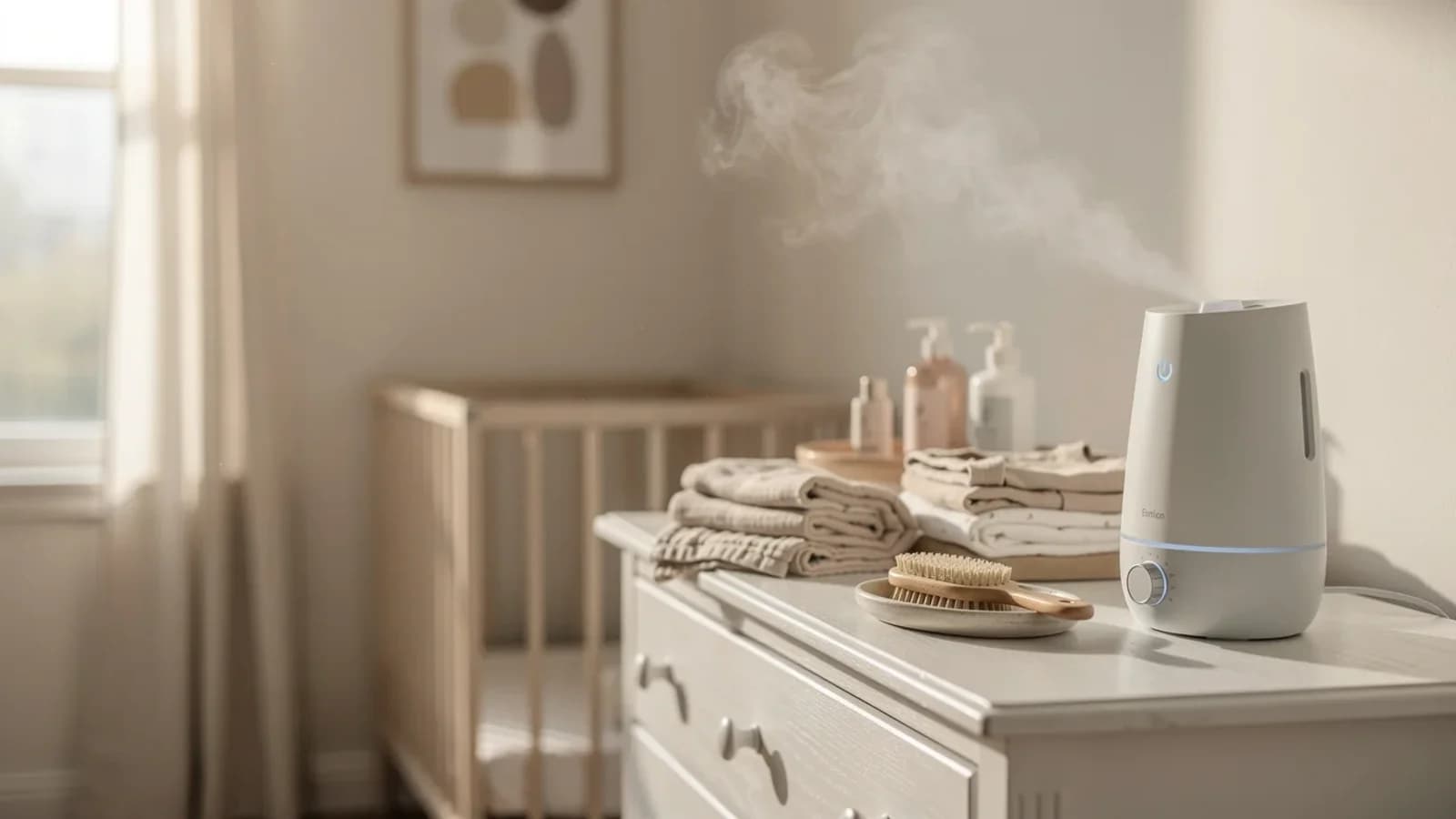
If you’re shopping for a humidifier for baby, it can feel weirdly complicated fast. Warm mist, cool mist, ultrasonic, evaporative, top-fill, night light, essential oil tray, filter-free, whisper quiet, nursery-sized, whole-room. It’s a lot.
The good news is that most parents do not need the fanciest option. A baby humidifier is usually a simple comfort-and-environment purchase, and the best pick is the one you can clean easily and use consistently.
This post is here to help you sort through the features without the overwhelm, especially if you want something practical, safe-feeling, and not destined to become one more annoying thing on your dresser.
Start with the type most parents actually want
For baby spaces, cool mist humidifiers are usually the first style people consider. They’re the most common nursery pick, they’re easy to find, and they fit the low-fuss setup a lot of families want.
You’ll usually see two main cool mist styles:
- Ultrasonic, which tends to be quieter and often comes with smaller nursery-friendly designs
- Evaporative, which uses a fan and can be a little less silent but often feels straightforward to operate
If you’re trying to keep your decision simple, I’d start by asking:
- Do you want the quietest machine possible?
- Do you mind replacing filters?
- Do you want something compact for a dresser, or bigger for a full room?
That alone narrows the list fast.
The features that matter more than the cute extras
A lot of baby humidifiers are marketed with adorable design details, but the most useful features are usually much less exciting.
Here’s what I’d prioritize first:
- Easy cleaning access so you can actually reach the tank and base
- Simple top-fill design if you hate flipping tanks over at the sink
- Auto shut-off when the water runs low
- Reasonable tank size for your nursery, not just the smallest unit on the shelf
- Low noise if it will run overnight
- Minimal extra parts if you know you won’t keep up with high-maintenance gear
Nice-to-have features can include:
- adjustable mist output
- a soft night light
- a timer
- a rotating nozzle
What I would not treat as a must-have is a long list of gimmicks. If a humidifier is hard to clean, all the bonus settings in the world will not make it more useful.
What to skip if you want less hassle later
This is where I think a lot of parents save themselves money.
If your goal is a practical nursery humidifier, I’d be cautious about buying based only on:
- the prettiest design
- the cheapest price
- an essential oil feature you may not even want to use in a baby room
- tiny desktop units that look cute but may be underpowered for the space
- hard-to-open tanks that turn refill time into a full production
A humidifier can be a solid nursery add-on, but only if it fits real life. If you’re already juggling sleep schedules, laundry, bottles, and the constant rotation of baby gear, easier is better.
That same practical mindset helps with other nursery purchases too, like choosing a carrier that fits your routine instead of just the trendiest option. If you’re building out your baby setup, you might also like this BabyBjorn carrier guide and this roundup of the best umbrella strollers.
How big should a humidifier for baby be?
Bigger is not always better, but too small can be frustrating.
Look at the room-size guidance and think about where the humidifier will actually sit. A compact nursery unit may be totally fine for a smaller room, while a larger bedroom may need more output and a bigger tank to avoid constant refills.
A few practical questions help here:
- Is the nursery small, medium, or shared with another space?
- Do you want it running only at bedtime or through the full night?
- Are you okay refilling daily?
- Will it live on a dresser, shelf, or table with enough stable surface area?
If you want a low-maintenance experience, a larger tank with simple cleaning access is often the sweet spot.
A simple shopping checklist before you click buy
Before adding any humidifier to your cart, I’d run through this short checklist:
- Type: cool mist ultrasonic or evaporative
- Cleaning: can you easily reach inside the tank and base?
- Tank size: enough runtime for your nursery needs?
- Noise level: quiet enough for overnight use?
- Footprint: does it fit your available surface space?
- Auto shut-off: yes, please
- Extra features: helpful or just clutter?
- Ongoing costs: filters or replacement parts?
If you want to browse options without locking into one brand yet, an easy starting point is an Amazon search for baby humidifiers.
And if you’re still in full baby-prep mode, this first trimester survival guide is a nice companion read for the bigger picture season of getting ready.
The best humidifier for baby is the one you’ll actually maintain
That’s really the whole thing.
The best humidifier for baby is rarely the one with the most marketing hype. It’s the one that fits your room, feels easy to refill, and doesn’t make you dread cleaning day.
If I were narrowing the field, I’d lean toward a simple cool mist model with easy-clean access, auto shut-off, and enough tank capacity to get through the night. That combination tends to be the most realistic for busy families.
You do not need perfection here. You just need something functional, manageable, and well-suited to your nursery.